



Air Canada urged the federal government to prevent a strike by flight attendants last summer by telling officials that the impact of service disruptions could be worse than that following the 9/11 attacks or the Covid-19 outbreak, according to documents obtained by Do Not Pass Go through a freedom of information request.
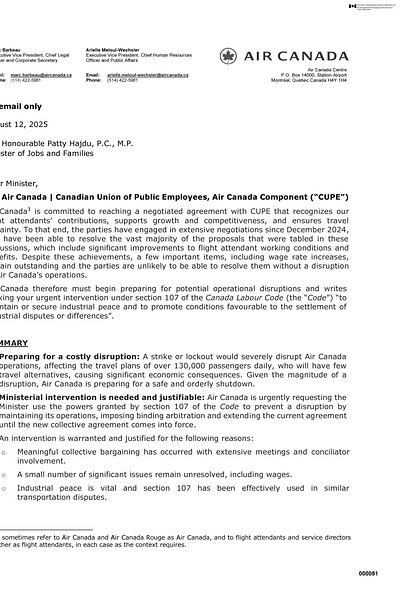
In an eight-page letter to Jobs and Families Minister Patty Hajdu dated Aug. 12, four days ahead of the strike that eventually went ahead on Aug. 16, executives warned that the expected shutdown of operations would have “significant economic consequences” for the airline and the country alike.
Air Canada was about to pull the trigger on grounding 249 aircraft across its network, which would affect 130,000 daily passengers covering 50 domestic and 115 international destinations, as well as cargo supply chains and “Canada’s reputation.” The airline also warned that full operational recovery could take seven to 10 days following the end of a strike action.
“The logistics involved and time necessary to affect the above may at first be difficult to appreciate,” wrote Marc Barbeau, chief legal officer and corporate secretary, and Arielle Meloul-Wechsler, chief human resources officer.
“Even the unplanned shutdown of airspace after 9/11 [in 2001] is not comparable. In that extreme case, passengers and crew largely remained in the same location for the duration of the grounding. Similarly, the significant scale down and ramp-up related to the pandemic [in 2020] is not comparable, notably as the return to pre-pandemic operations occurred over many months.”
The airline urged Hajdu to take the unusual step of invoking Section 107 of the Canada Labour Code, which allows the minister to intervene in employment disputes to “maintain or secure industrial peace and to promote conditions favourable to the settlement of the industrial disputes or differences,” before an actual strike began.
“Delaying intervention until a work stoppage occurs seems to be more about encouraging the parties to present their best positions, rather than permitting them to use their strike or lockout rights, which, as experience shows, then only lasts for a limited period,” the letter says.
“If the intended purpose is to push parties to the brink, then that moment in our case is when our orderly shutdown must be activated… rather than 72 hours later when a work stoppage has formally begun. Once the costs of a shutdown begin to be absorbed there is less impetus to advance what might have been advanced earlier. In other words, the most generous employer offer is likely to be the one that avoids the costs of a shutdown. There is at present no useful purpose in refraining from acting now.” (Bolding from original letter, read it here:)
Hajdu did not invoke Section 107 prior to the strike, but did so just hours after it began. The Canada Industrial Relations Board ordered the airline’s 10,400 flight attendants back to work shortly after.
The attendants, who were seeking a number of concessions from Air Canada including pay for the time they spent on the ground, reacted angrily – they refused to comply and called the order a “betrayal” by the Liberal government. The strike ultimately ended three days later, on Aug. 19, after the airline caved on key points, including some limited pay for groundwork.
Air Canada spokesperson Peter Fitzpatrick says a negotiated settlement with the union was always the airline’s preferred outcome, but it was forced to explore back-up plans – including requesting the use of Section 107 – to ensure continuity of operations.
“Failing a negotiated settlement, we viewed the government’s immediate intervention as necessary because of the nature of the airline business,” he says. “Unlike other businesses that can be shut down and reopened simply by opening the door, the airline business is very complex and shutting down and restarting is not easy.”
He added that the expected shutdown would have left aircraft parked all over the world, which would have put them out of position when the time came for a restart.
“This is the context in which we discuss other major events, such as 9/11, that brought the industry to a complete halt… even those events are not comparable for us because the restart was more complex than what we experienced for reasons explained in the letter. The intent was also to convey the extent of the knock-on effects of a work stoppage, particularly during the summer peak when millions of Canadians were relying on us for their holiday plans.”
The Canadian Union of Public Employees (CUPE), which represents Air Canada’s flight attendants, says comparisons of a potential strike-related shutdown to those caused by security- and health-related disasters are disingenuous.
“It was a total scare tactic because they were in full control,” says Wesley Lesosky, president of CUPE’s Air Canada component. “9/11, respectfully, they weren’t in full control of, the same with Covid. This was a strike, and to avert a strike you have to either put in more money or be prepared to lose money. I don’t necessarily buy their argument, only because they were in control of their destiny.”
Gabor Lukacs, head of the Air Passenger Rights advocacy group, says the letter is also more troubling evidence of Ottawa’s cozy relationship with the nation’s airlines.
“Air Canada is telling a minister what to do and the minister is obediently complying, like a lackey,” he says. “Having to shut down the network is another myth – the airline can and should operate their flights while the employees are still available. Had Canada had EU-style passenger protection, Air Canada would not have dared to play this kind of game with its employees and the public.”
Separately, the Canadian Transportation Agency this week fined Air Canada $426,000 for 71 violations of the Air Passenger Protection Regulations during the strike, for failing to refund tickets or provide customers with alternative flights on other carriers. The Montreal-based airline, which in February reported full-year revenue for 2025 of $22.4 billion and earnings before interest, taxes, depreciation and amortization of $3.1 billion, says it plans to appeal the fine.
Employment and Social Development Canada did not provide a response to queries by the requested deadline of Tuesday afternoon in regards to why Hajdu invoked Section 107 so quickly, or which – if any – of the statements made by Air Canada in its letter affected her decision.
Following the strike, the minister ordered a probe into allegations that flight attendants were being expected to do unpaid work. The government in February published findings from the first phase of its investigation, which was that more data is needed.
Hajdu reported that, while the government heard stories from union members about not being fully compensated for delayed flights, their anecdotes couldn’t be verified by pay records. “That’s not to say it isn’t true,” she told the Canadian Press. “That’s just to say that the records aren’t matching.”
Lesosky says CUPE is not happy with the current, second phase of the investigation because it is centring around the airlines self-auditing their own pay records.
“I have zero satisfaction with it because we’re not part of it.”
Canada has a lot concentrated sectors that are run by a few companies.
There’s got to a system to work out an equitable agreement.
Every time a sector shuts down the country gets a black eye.
An unhappy worker does not improve productivity.
Air Canada’s letter to Minister Patty Hajdu compared a strike shutdown to the 9/11 airspace closure. They pushed hard for early Section 107 action under the Canada Labour Code to keep planes flying. She stepped in hours after the walkout started anyway. I checked the HUMA committee evidence. CUPE reps said the tactic killed bargaining trust. Quick fixes protect passengers but skip real talks every time. https://www.ourcommons.ca/DocumentViewer/en/45-1/HUMA/meeting-20/evidence