


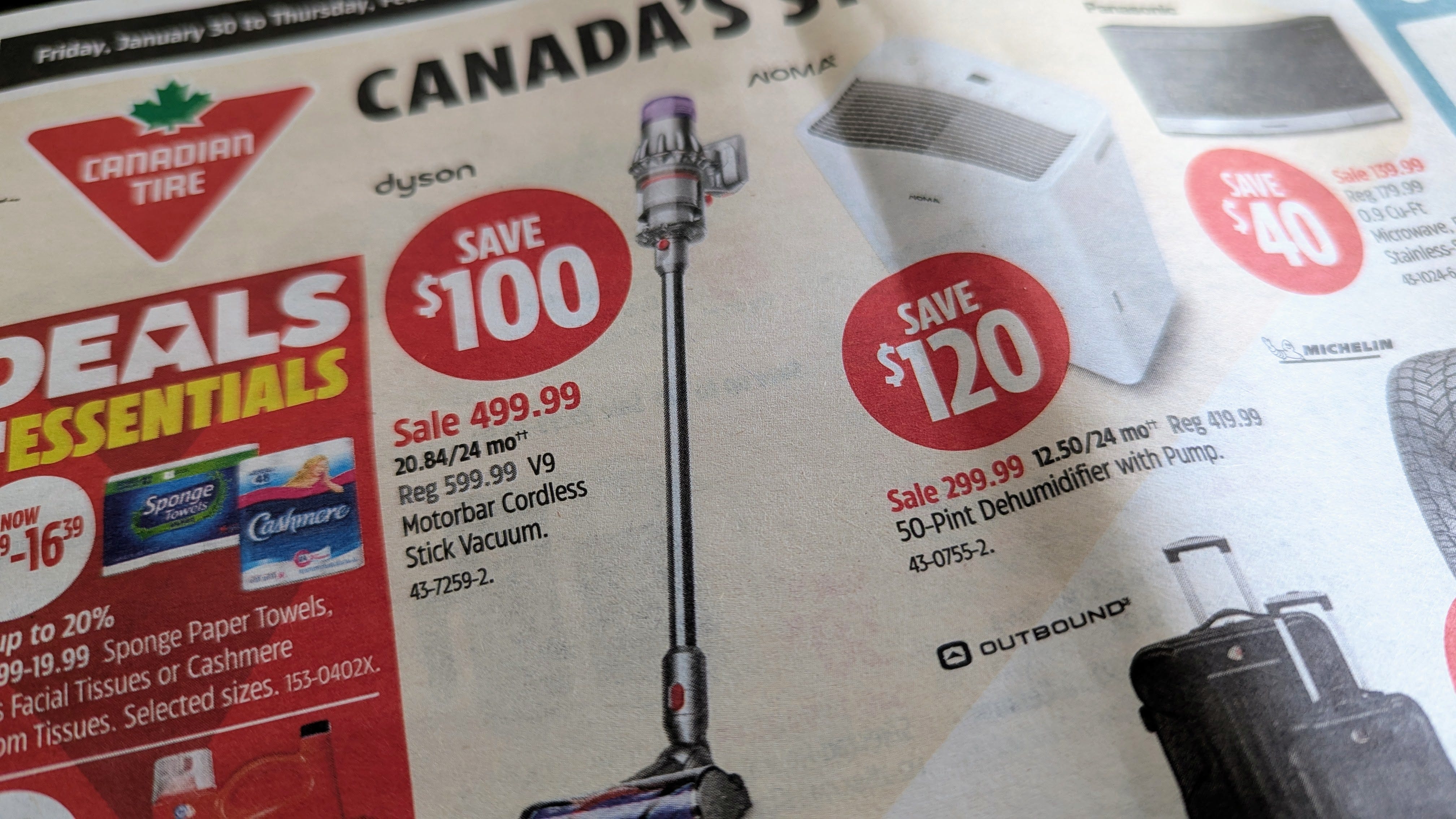
FEB. 6 UPDATE: Canadian Tire pleaded guilty to the charges described below in Quebec court and will pay a $1.2 million fine, plus legal costs.
In a news release, the province’s Office of Consumer Protection revealed that it had verified actual prices versus those advertised in flyers and online over a six-month period on seven targeted products in three stores in the greater Montreal area.
“Analysis of sales data showed that the products were sold at the regular price in only a very small proportion of cases,” the OPC said. “The investigation also established that in stores, the products were almost never displayed at the regular price during the verification period.”
Canadian Tire admitted guilt on the five products listed below.
A company spokesperson responded to Do Not Pass Go with the following: “The OPC charges relate to five products over a six-month period five years ago. Importantly, no customers were overcharged and the matter is now concluded.”
ORIGINAL STORY FOLLOWS:
Quebec prosecutors are bringing charges against Canadian Tire for falsely advertising prices on products, thereby violating the province’s consumer protection laws.
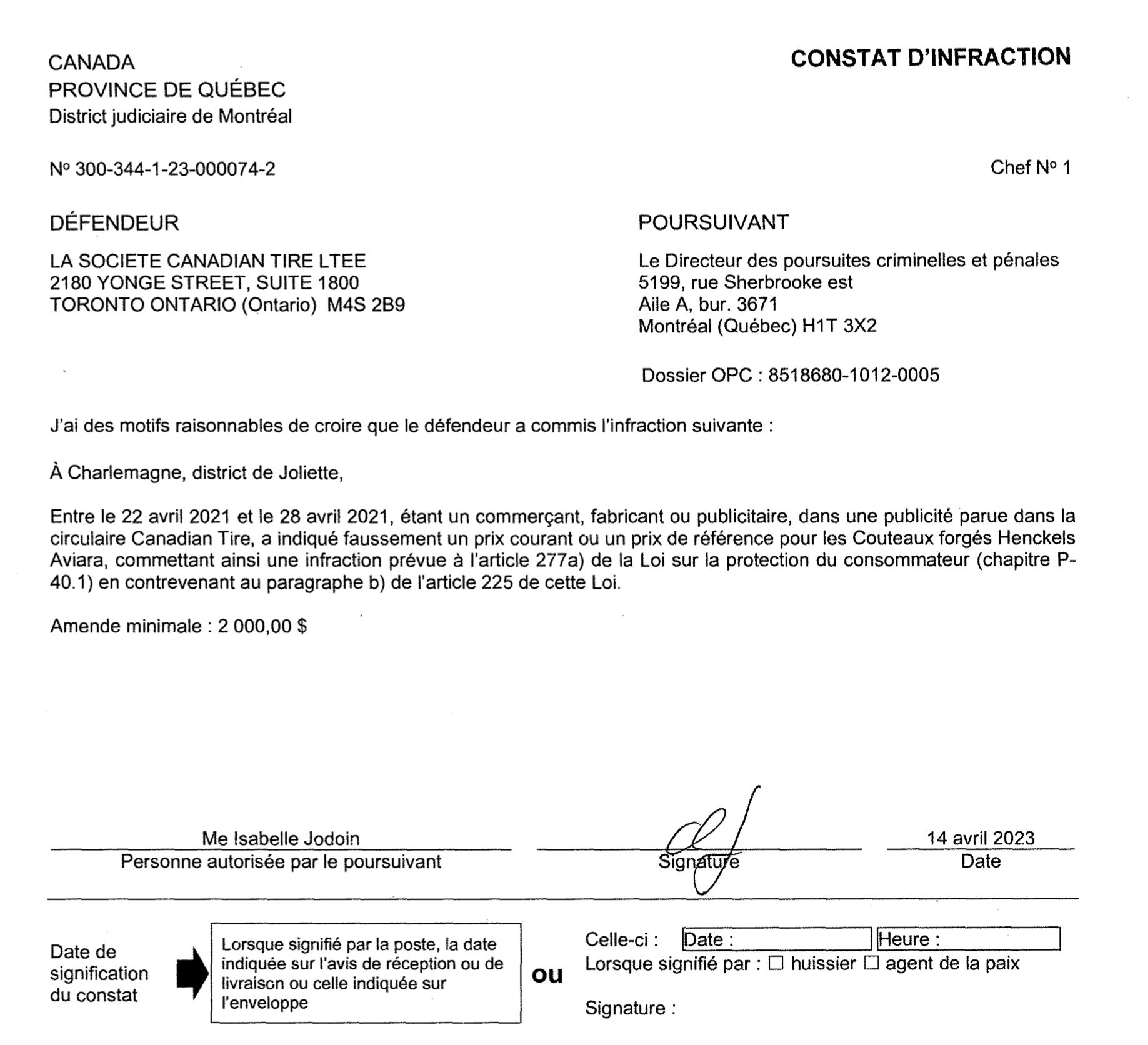
In 74 statements of offence filed with the Court of Quebec, district of Montreal, the Directeur des poursuites criminelles et pénales (DPCP) alleges that the retailer “falsely indicated a regular price or reference price” for several products in flyers or online between April 2021 and October 2021.
The products in question are Henckels Aviara forged knives, Dewalt cordless drills, Cuisinart Japanese forged knives, Heritage Elite cookware and Lagostina commercial clad cookware. All the offences allegedly took place in the town of Charlemagne, just northeast of Montreal.
The DPCP says the Toronto-based retailer is in violation of section 225 of Quebec’s Consumer Protection Act, which states that merchants cannot “falsely, by any means whatever, invoke a price reduction, indicate a regular price or another reference price for goods or services, let it be believed that the price of certain goods or services is advantageous.”
The statements of offence each carry a fine of at least $2,000 each, indicating a total minimum fine of $148,000. A DPCP spokesperson would not say whether the prosecutor was seeking a higher penalty.
The charges were originally signed by the DPCP on Apr. 17, 2023, and were filed with the court last month. The spokesperson would not comment on the timeline because “it pertains to the investigation.” A court hearing is scheduled for Feb. 7.
The evidence for the case was compiled by the province’s consumer protection agency, the Office de la protection du consommateur, which declined to answer questions about the amount of the fine or settlement being sought and the timeline.
Aside from grocery chains including Walmart and Costco, Canadian Tire is Canada’s largest bricks-and-mortar-based retailer, with more than 1,700 outlets across its own brand, plus SportChek, Mark’s, PartSource and others.
A spokesperson could not immediately comment on the allegations, which have not been proven in court. This story will be updated with any Canadian Tire response, either before or after the Feb. 7 court hearing.
A CBC Marketplace investigation into Canadian Tire and Old Navy last year found numerous discrepancies in advertised prices versus full list prices or other advertised claims.
In Canadian Tire’s case, Marketplace tracked prices over seven months and compared discounts through several events over that time, including Black Friday and Boxing Day.
“After looking at 46 items on the Canadian Tire website from June 2024 to January 2025, Marketplace found 20 went on sale during those big sales events — but more than half of the 20 products were actually the same sale price or cheaper at some point earlier in the year,” according to the investigation.
The company responded to CBC by saying it runs carefully planned promotions.
“There are many factors that are taken into consideration when determining the pricing and promotions of our products, and we indicate to our customers in our weekly promotions whether or not the lowest price of the season or year is being offered,” a spokesperson said in an email.
The DPCP’s case follows a similar prosecution against the Hudson’s Bay Company in 2019, which it ultimately lost. The prosecutor alleged that the retailer had advertised a regular price on a Serta mattress set, but that it rarely if ever sold the product at the supposed full price.
Although the court found that The Bay had engaged in this form of “high-low pricing,” which is illegal in Quebec, the prosecution failed to prove that the full “regular” price was not real or legitimate.
The prosecution’s case was complicated by the fact that no other retailers were called as witnesses to provide evidence of competing prices for a similar product – which was largely because the particular mattress set, the “Wynnewood Collection,” was exclusive to The Bay.
The company testified that the mattress in question had “premium” quality features and could therefore not be compared to those sold by other retailers, which made it impossible for the court to determine whether The Bay’s full list price “was not real or legitimate.”
Despite that, Magistrate Justice of the Peace Johanne White noted that The Bay had not sold a single mattress at the full price over the time period of the investigation, and that it was “nonetheless striking that the product was offered nearly half the year at a discount exceeding 60 per cent of its regular price.”
In her determination, Justice White also noted the purpose of the laws regarding regular pricing: “False sale advertising is misleading and regulated because it harms fair competition by attracting consumers away from honest merchants.”
The Competition Bureau has similar ongoing investigations into Leon’s and The Brick, furniture retailers based in Toronto and Edmonton respectively, for alleged misleading sales claims, inflated regular prices and the use of fake urgency cues.
The agency also concluded a $3.25 million settlement in 2023 with furniture retailer the Winnipeg-based Dufresne Group, better known for its Dufresne Furniture and Appliances and certain Ashley HomeStores brands, over a case involving inflated regular prices and the use of fake urgency cues.
I used to work in the home furnishings retail industry. Every mattress manufacturer rebrands its models uniquely to the retailer for just this reason. They’ll make slight adjustments to the build and marketing description to make it hard for consumers to price compare. Instead they insist that you lie down on the demo in the retail showroom, knowing that you’re not going to do this over and over again. They also rebrand models just for sales events so that you can’t compare old price to sale price. It’s price fixing but designed to make it very hard to win in court.
Amazon does this almost every day.