


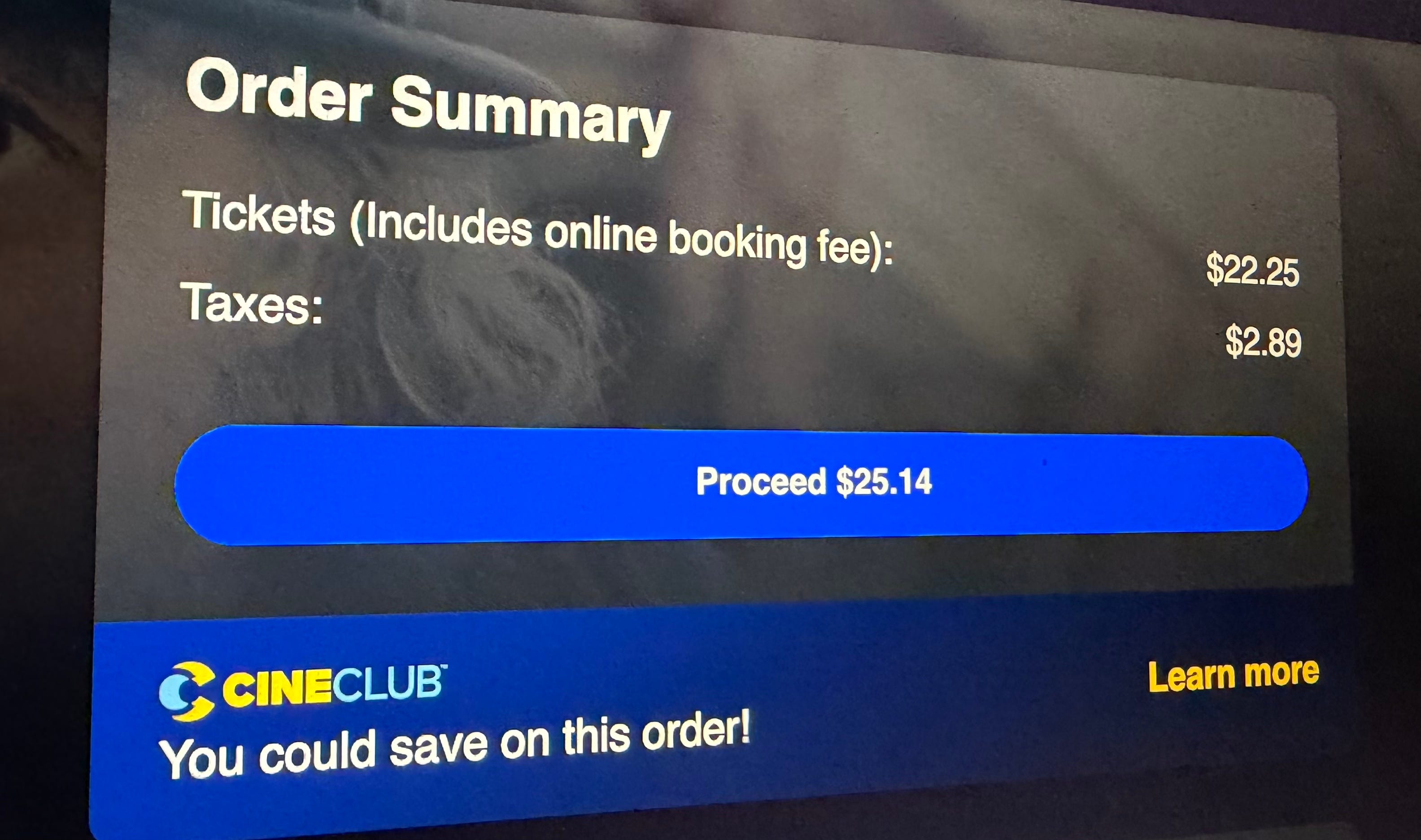
Cineplex continues to rake in millions from junk fees even as it fights a record $38.9 million penalty for misleading movie-goers about those very charges.
In its third-quarter results released last week, the Toronto-based theatre chain disclosed it earned $22 million from online booking fees in 2025. That amount is likely to be higher this year, as “other” revenue was up 24 per cent in the quarter over a year earlier “reflecting increased online booking fee revenues associated with stronger attendance,” as well as contributions from Cineplex’s distribution business, chief financial officer Gord Nelson told investors on a Nov. 6 conference call.
The company was hit with the $38.9 million ruling – the largest Administrative Monetary Penalty (AMP) ever imposed by the Competition Tribunal – in September 2024, following a case brought by the Competition Bureau. The Bureau successfully argued that Cineplex’s mandatory $1.50 online service was a deceptive hidden charge that misled consumers about the actual price of their movie tickets.
The Tribunal pegged the penalty to the amount Cineplex collected through the fee between June 2022 and December 2023. As part of the outcome, the company agreed to disclose the fee to customers more clearly. It would also not have to pay the penalty until any appeals were resolved.
Cineplex did in fact challenge the ruling, but the Federal Court of Appeal upheld the Tribunal’s decision earlier this year. The court rejected the company’s arguments that customers could easily discover the fee by scrolling down its website, and that it wasn’t mandatory because they could avoid it by getting tickets in person at a theatre. Cineplex is now seeking leave to appeal with the Supreme Court.
Meanwhile, two related class-action lawsuits are underway in British Columbia and Quebec, with both seeking compensation for customers who paid the fee. Unlike these proposed lawsuits, the Tribunal’s penalty would go to the Crown rather than directly to affected consumers.
A Cineplex representative did not respond to questions over why the company continues to charge the online service fee.
While the Tribunal found that the way in which Cineplex was disclosing its fee was deceptive, it did not bar the company from charging it altogether. If the Supreme Court declines to hear the appeal or if it upholds previous decisions, any new revenue Cineplex has accumulated is therefore not likely to be added to the penalty. That may not be the case with the class-actions, however.
“They’re free to keep charging it as long as it’s above board,” says Neil Hartung, a lawyer with the Consumers Council of Canada. “But it’s a BS fee anyway.”
The continued revenue stream is notable given Cineplex’s commanding position in the movie theatre market. In its investor materials, the company reported that it controls 74 per cent of Canada’s box office, compared with just 14 per cent for its closest competitor, Landmark Cinemas.
For its third quarter, Cineplex reported $440.2-million in revenue, up from $348.9 million a year earlier, with profit of $23.8 million compared to $1.2 million. Box office revenue per patron was $14.54 for the quarter, up from $13.23, with attendance rising to 14.8 million people from 12.1 million thanks to a strong film slate that included The Odyssey and Spider Man: Brand New Day.
On the Nov. 6 investor call, new chief executive Bill Walker – formerly the head of Landmark – highlighted Cineplex’s market dominance and its Scene+ loyalty program, which counts Scotiabank and Sobeys owner Empire as partners.
“We’re a data-driven entertainment and media company,” Walker said. “The combination of our exhibition business, the location-based entertainment, together with consumer insights through Scene+, create a powerful advantage that is difficult to replicate.”
That advantage could prove particularly valuable as Cineplex considers its next move. The company is currently in the midst of a strategic review that could include a sale of the chain. Walker told investors that Ellis Jacob, the company’s previous CEO, is acting as a strategic advisor on the review.
🎧 ON THE PODCAST THIS WEEK:
The Banking Oligopoly We Deserve?

Building on last year’s federal budget, this year’s just released version adds new measures to make Canada’s banking sector more competitive, including the lowering of barriers to entry for challengers and – at long last – the implementation of a “real-time rail” system that will significantly speed up fund transfers between institutions.
💾 BIG TECH
NVIDIA chief executive Jensen Huang resigned this week following reports of affairs with multiple women, one of whom U.S. authorities suspect of being a Chinese spy. The woman in question has ties to Megaspeed, a data-centre company in Singapore that is also accused of routing restricting chips to Chinese customers. Nvidia, which dominates the market for processors that power artificial intelligence, says it has no reason to believe that national security was comprised, but the situation could potentially have huge repercussions for the global economy. Huang was seen as integral to the company’s success, and if Nvidia takes a downturn as the result of his departure, so too could world markets – highlighting the problem with concentrating market power in a key sector with one supplier.
🏭 MANUFACTURING
Steel maker STELCO is recalling 175 workers on Dec. 1 as its parent CLEVELAND CLIFFS appears to have blinked in its standoff with the federal government. Industry Minister Melanie Joly last week asked the Competition Bureau to look into whether the U.S. company had acted in bad faith when it acquired Hamilton, Ont.-based Stelco in 2024. In a letter to Acting Competition Commissioner Jeanne Pratt, Joly pointed to comments by chief executive Lourenco Conclaves, who told the CBC in late October that he bought the steel maker because he couldn’t afford to have it “flooding the market here in the United States to the detriment of my own company.” In her letter, Joly called the remarks a “shocking admission” and questioned whether the company’s conduct warrants enforcement action under the Competition Act. The Bureau had previously reviewed the $3.4-billion takeover and issued a no-action letter. Joly is now asking it to reconsider in light of the CEO’s comments. The company says it is recalling the workers because of a sudden increase in demand for steel.
🛒 GROCERY & RETAIL
What happens when grocers including LOBLAW conspire to fix the price of bread in order to bilk consumers out of millions of dollars, and then fraudsters conspire to bilk the conspirers? That scenario is at the centre of a new Globe and Mail investigation that reveals how up to $8.5 million of the $500 million bread price-fixing settlement was exploited by individuals who were not affected. The problem is that claimants had to do little to prove they were indeed affected, even if they were legitimate, leaving the runway clear for scammers to avail themselves of the funds. As the article points out, the situation is proof that Canada needs stronger safeguards for ensuring that class-action payouts go to their rightful recipients.
A merger in the food kit delivery field was announced this week, with Vancouver-based FRESH PREP buying Montreal’s GOODFOOD out of creditor protection. Financial details weren’t disclosed, but Fresh Prep says it is the nation’s largest-owned Canadian-owned meal delivery company. Ordinarily, consolidation in a sector is reason for concern, but with Canada having no shortage of meal kit delivery companies, this one is perhaps necessary if not welcome given the significant downturn in the business since the pandemic. Market leader HELLO FRESH, for example, has seen its share price drop by 82 per cent over the past five years.
🏈 SPORTS & ENTERTAINMENT
It isn’t just fans upset about what ROGERS is doing with NHL broadcasts – a trio of television providers are now accusing the company of violating competition rules with how it’s parcelling out games. COGECO, SASKTEL and EASTLINK have written a letter to the Canadian Radio-television and Telecommunications Commission to complain about how Rogers is forcing fans to pay an extra $12.99 to watch Monday night hockey games unless they already subscribe to Sportsnet on Rogers TV, or the Sportsnet Plus streaming service. The three smaller TV providers want the regulator to force Rogers to offer the content to independent distributors for free to ensure “parity” with the company’s own services. “Left unchecked, this strategy erodes consumer choice, forces Canadian households into mandatory fee-stacking, and distorts fair market dynamics,” the companies said in their letter.
🚨 COMING UP
Have you got that uneasy feeling that you’re being ripped off everywhere you turn? It’s not your imagination, according to LINDSAY OWENS. In her new, appropriately titled book Gouged, the consumer advocate and Groundwork Collaborative think tank director goes into the numerous ways that retailers and merchants are… well… gouging people. She joins the Do Not Pass Go podcast this Tuesday to talk about how it’s happening, why it might be changing, and how consumers can protect themselves in the meantime.
I pulled sections 74.01 and 74.1 of the Competition Act to check why that ruling neither bans the fee nor pays moviegoers. Section 74.01(1.1) (the drip-pricing rule) targets advertising a price unattainable due to fixed obligatory fees, so a 10-year order under paragraph 74.1(1)(a) bars hidden disclosure rather than the fee itself. Subparagraph 74.1(1)(c)(ii) caps corporate penalties at three times the benefit (or $10 million for a first order, whichever is greater), while subsection 74.1(4) limits orders to promoting conformity rather than punishment. Restitution (consumer refunds) under paragraph 74.1(1)(d) is discretionary and covers paragraph 74.01(1)(a) only.