


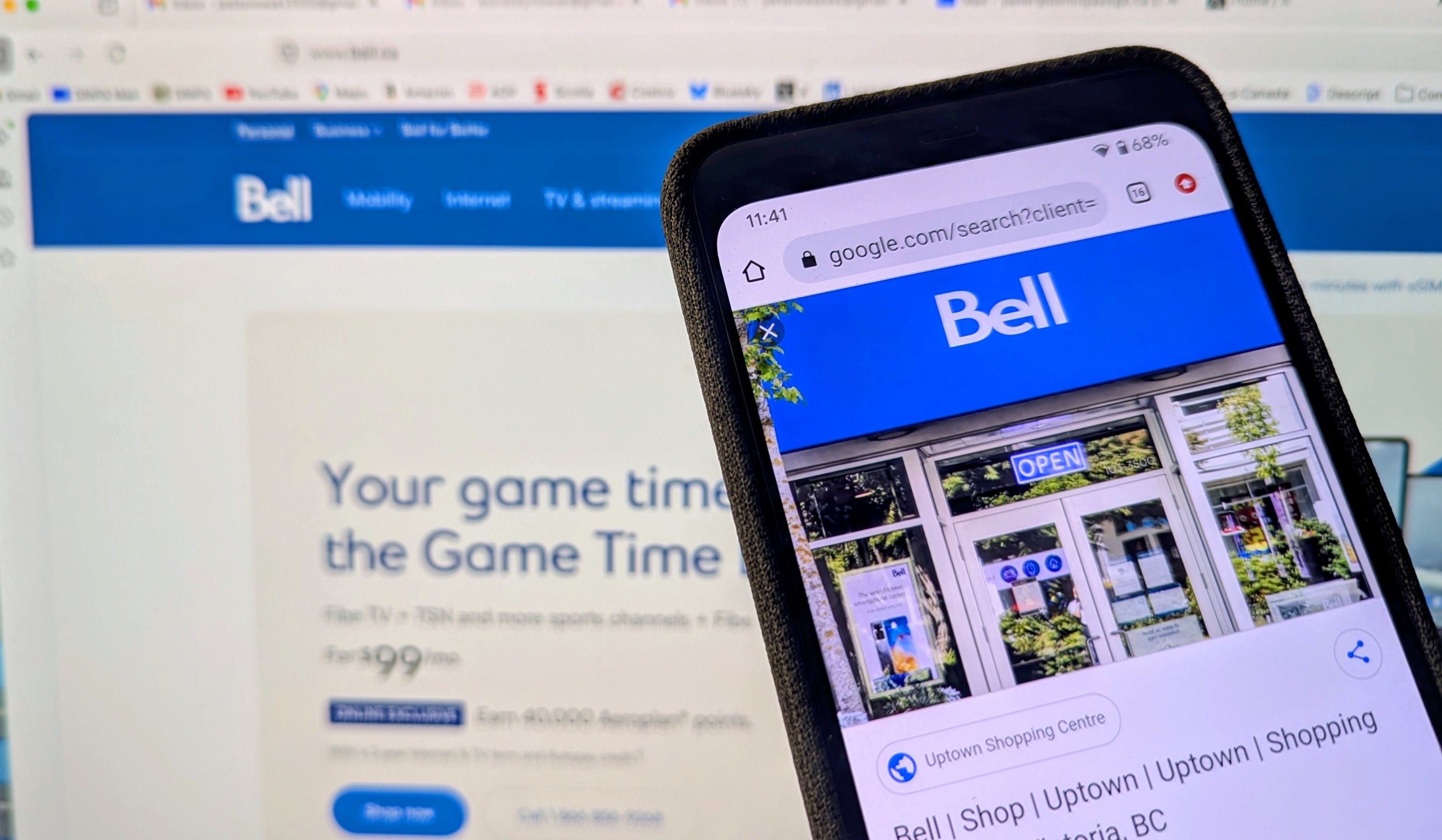
The CRTC wasted no time in admonishing Bell this week after it was revealed that the company was trying to get around new regulations that prohibit service activation fees.
In a letter dated May 6, the regulator informed Bell that it does not consider the company’s recently introduced $40 “handling” fee on new smartphones to be exempt from rules that prohibit charges that act as barriers to customers switching services.
“A phone is a device that is required for the delivery of the wireless service customers are purchasing,” writes Scott Hutton, vice-president of consumer, analytics and strategy at the CRTC. “A fee associated with providing a phone may be considered to be an activation fee that is prohibited” under the Telecommunications Act.
The rules, which were announced in March and come into effect on June 12, are meant to make it easier for customers to switch between plans and providers. Carriers including Bell have been steadily increasing activation fees for new customers, with charges reaching as high as $80.
News of the handling fee was first reported by MobileSyrup. Bell says the company is reviewing the CRTC’s letter, with the fee still being in place as of Friday afternoon.
“We introduced this one-time device handling charge as a transactional fee to cover fulfillment costs and it applies only to the optional purchase of a device,” a spokesperson says. “This charge does not apply to bring your own phone customers.”
In its letter, the CRTC is urging Bell to drop the fee on its own, or else.
“It is my hope that this situation can be resolved at this stage and will not require more formal regulatory action on the part of the Commission once the prohibition comes into effect,” Hutton wrote.
📱 TELECOM
Also this week, BELL fired dozens of employees for coffee badging, or the post-Covid phenomenon of coming in to work and swiping one’s badge to prove attendance, only to then go home shortly after. The company says the employees were terminated for cause, with some engaging in egregious behaviour. One employee apparently swiped in just before midnight and then again shortly after so as to show their attendance two days in a row. Another entered the building to use the gym before going home. Some of the affected employees are considering legal action, according to the reports, saying they were encouraged to coffee badge by their managers as long as they hit their work targets and that their terminations are merely a way for Bell to cut jobs without paying severance.
In something of a bombshell, it was revealed this week that TELUS has deployed artificial intelligence to alter the accents of its customer service agents. The technology works in real time and modifies pronunciation and the “acoustic features of speech, preserving the speaker’s voice while improving clarity and reducing accent-related friction,” according to a post on the company’s Telus Digital subsidiary website. To say that the revelation raised eyebrows would be an understatement, with Unifor recently telling Parliament that telcos were offshoring customer support and then altering how customers were perceiving who they were talking to. “The use of AI technology to deceive Canadians in any way should be prohibited,” a union rep said.
Both the Competition Bureau and ROGERS made their closing arguments in court last week in the agency’s false advertising case against the company. The Bureau is arguing that the company is falsely marketing its Infinite wireless phone plans as having unlimited data when in fact the plans have data caps and speed reductions. For its part, Rogers is saying that the word “infinite” shouldn’t be confused with “unlimited.” The arguments aren’t publicly available yet and there’s no word on when the Competition Tribunal may rule on the case, though we’ve heard that such decisions may take two or three months.
ON THE PODCAST THIS WEEK:
The Competition Act Turns 40: What Canada Has Right – and Wrong

Fun fact: Canada once led the world in fighting monopolies.
🥊 COMPETITION
Following a promise in the fall budget to take action on non-compete clauses in employment contracts, the federal government this week published draft legislation to that effect. The key addition is allowing the Governor in Council to make regulations against contract terms that “unreasonably restrict the ability of employees to engage in any business, work, occupation or trade, profession, project or other activity.” According to one law firm’s interpretation, this means the proposed legislation extends “beyond restricting non-compete clauses and broadly includes other employment-related restrictions.” It’s unclear what these might mean and are being left to the discretion of the Governor in Council.
🛢️ RESOURCES
In its first merger challenge since its bruising defeat at the hands of Rogers-Shaw, the Competition Bureau is heading back to court in an attempt to stop Calgary-based KEYERA’s $5 billion acquisition of Houston-based PLAINS ALL AMERICAN. Lawyers for the Bureau this week said that the deal, if allowed to proceed, would significantly reduce competition for natural gas liquids at a key hub in Fort Saskatchewan, Alta., and give the merged company greater ability to raise prices and impose worse contract terms on customers. “The bureau is taking this action to protect competition at a critical energy hub and to ensure that Canadian producers are not harmed by increased concentration and reduced choice,” said interim commissioner Jeanne Pratt in a statement. Keyera disagrees with the assertion and says the challenge doesn’t prevent the transaction from closing.
🏦 BANKS
It’s tough out there for small and medium-sized Canadian businesses, especially when it comes to securing loans. A new report from SOCIAL CAPITAL PARTNERS titled “Built to Exclude” hones in on the problem – that Canada’s large deposit-funded banks, while admired internationally for their stability, are built to avoid risky lending. As a result, only 11.5 per cent of all outstanding business loans went to Canadian SMEs between 2019 and 2024, compared to an average of 44 per cent across peer nations. Check out the report, it’s a good read.
The federal government has approved EQ BANK’s $800 million purchase of PC Financial from LOBLAW, which will boost the upstart company’s customer base to 3.3 million from around 800,000. EQ, which is Canada’s seventh-biggest bank, says there will be no immediate changes for PC customers once the deal closes this summer.
🕺 ENTERTAINMENT
As lawyers in New York discussed how to proceed with the penalties phase of the LIVE NATION antitrust case this week, the company continues to maintain that it isn’t a monopoly. “I think it's pretty clear that the states who brought the case along with the federal government asked for a jury trial because it's a lot easier to win a jury trial than it is a [judge alone] trial in a case like this, particularly against a big corporation,” executive vice-president Dan Wall tells CBC. “And I'm not happy with the verdict, of course.” In the wide-ranging interview, Wall defends high concert ticket prices as products of demand and lower subsidies from record labels.
👕 CLOTHING
Big Uniform is attracting regulatory attention, with both the U.S. Federal Trade Commission and Canada’s Competition Bureau reviewing the proposed $5.5 billion (U.S.) takeover of UNIFIRST by CINTAS. Ohio-based Cintas is the largest player in the North American uniform rental market, with an estimated share of around 30 per cent, while Boston-based UniFirst has around 10 per cent. The Bureau launched its review on Apr. 24, around the same time as the FTC began speaking to the firms’ U.S. customers. One report suggests that some customers in the space are opposed to the merger because they view Cintas’ contracts as “authoritative” and “oppressive.”
🚧 CONSTRUCTION
The Competition Bureau is also reviewing a merger by QXO and TOPBUILD, two U.S.-based building products distributors that supply contractors in Canada. In announcing the $17 billion (U.S.) deal last month, QXO said that the deal will make it the second largest publicly traded building products distributor, with leadership positions in insulation, roofing, waterproofing and lumber and building materials in key geographies. While the industry is fragmented, QXO has been on a roll-up binge of late, acquiring Beacon Building Products for $11 billion last year and lumber distributor Kodiak Building Partners earlier this year for $2.25 billion. The Bureau opened its review of the TopBuild deal on May 1.
🛒 GROCERIES & RETAIL
Not everybody is a fan of MANITOBA’s ban on grocery stores using real estate exclusivity contracts to limit competition. The Canadian Federation of Independent Grocers says there shouldn’t be a one-size-fits-all ban and that there are some situations where such deals make sense. Some smaller store owners are also saying the province should instead go after manufacturers and wholesalers if it really wants to bring down the cost of food.
🚨 COMING UP
And for more on this very topic, check out the Do Not Pass Go podcast this Tuesday. JACOB FILIPP works in marketing, but his side hobby is tracking the restrictive real-estate covenants that grocery stores are using to kill competition. He joins us to explain the problem and how eliminating covenants can lead to lower food prices.
"For its part, Rogers is saying that the word “infinite” shouldn’t be confused with “unlimited.”
Pardon my confusion but about 7 dictionaries defined the word unlimited as infinite.
If I were Ed Rogers, I'd be looking for a better marketing team. Perhaps one that can use a dictionary...