


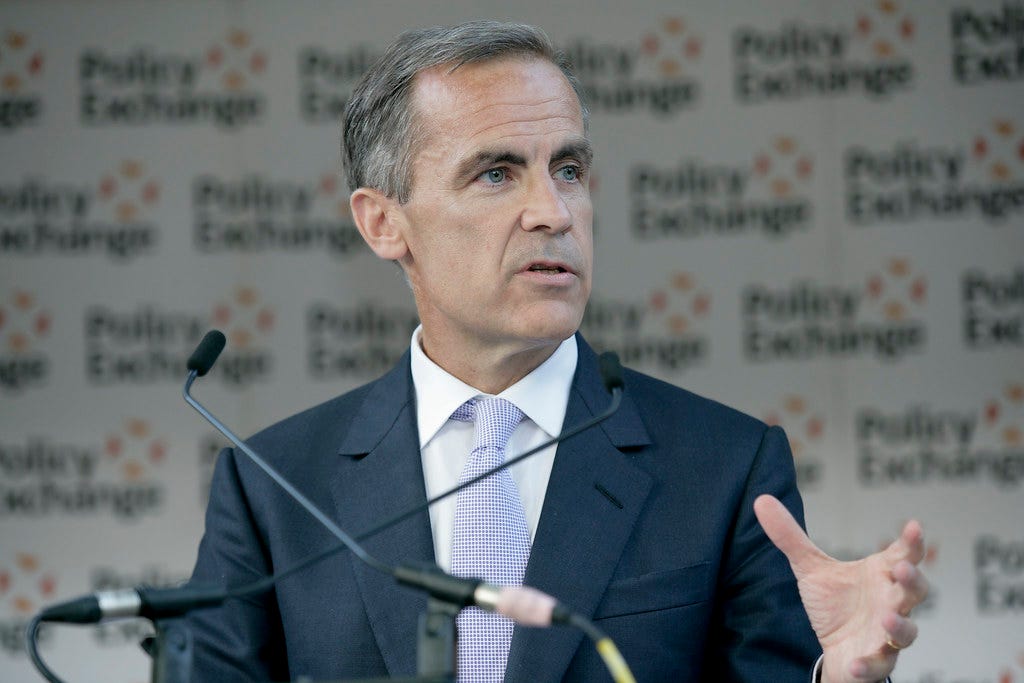
The federal government’s announcement of a sovereign wealth fund, more spending on trades workers and sports, and even a ban on cryptocurrency ATMs got most of the headlines from this week’s spring economic update, but some big competition news was also part of it.
The update from Prime Minister Mark Carney and his crew included a promise to introduce a whole-of-government competition plan that will “seek to ensure that existing and future policies across the federal government prioritize the promotion of competition and limit to the extent possible the potential negative impacts on competition that can, often inadvertently, stem from government policies.”
Details are scant so far, but the plan “will focus on removing inefficient government policies that impede competition arising from regulation, procurement and industrial support,” according to the update release, with more information promised in the coming months.
Carney’s 1995 Oxford thesis, “The Dynamic Advantage of Competition,” famously argued for strong antitrust enforcement and against preferential treatment for big national champions, but his government has for the most part avoided taking major steps to that effect so far.
Competition advocates welcomed the plan announcement as a possible indicator that this is about to change, though they attached the usual caution about the devil and the details.
“This is a positive sign and we’ll be watching to see whether the headline is backed up with real action to provide Canadians with more affordable choices in important markets,” said the Canadian Anti-Monopoly Project in a statement on LinkedIn.
With few details to go by, it may be instructive to look to a similar plan enacted in the United States under President Joe Biden in 2021. His “Executive Order on Competition” instructed more than a dozen federal agencies to take 72 separate initiatives designed to counter anti-competitive practices.
A handful of these included strong enforcement of merger laws, limiting non-compete clauses for employees, reinstating net neutrality rules and even allowing for hearing aids to be sold over the counter.
Politico called the order, “the most ambitious effort in generations to reduce the stranglehold of monopolies and concentrated markets in major industries,” which is why it was unsurprisingly repealed by President Donald Trump last year.
Biden’s order was largely authored by Tim Wu, the Columbia law professor who grew up in Toronto. In discussing the order in a keynote address at the Competition Summit in Ottawa in 2023, Wu said the revival of competition policy must be supported by the highest levels of government and that the movement must be both intellectual and political. He also stressed that such a whole-of-government plan is a long process.
In his appearance on the Do Not Pass Go podcast back in October, Wu also talked about the risks associated with such an order and how he was somewhat relieved that Trump struck it down.
“The idea of that was to give the White House a role in providing direction to all the agencies, so maybe he’d say like, I don’t know, ‘just go investigate all the agencies owned by Democrats or by black people… or like let’s go hunt down immigrants or some crazy thing,” he said. “I would hate to have antitrust and competition become the excuse for yet another political purge or an attack on private industry.”
The whole-of-government approach has also been championed by Matthew Boswell, who served as Competition Commissioner for seven years before stepping down at the end of 2025. On the very first Do Not Pass Go podcast, Boswell expressed regret that he was not able to get such a plan instituted before his term ended.
Neither Wu nor Boswell responded to requests for comments on the Carney government’s announced plan, but it wouldn’t be a surprise if one or both end up involved in crafting the details over the months to come.
🥊 COMPETITION
Another less-heralded tidbit from the spring economic update was some good news for EMPLOYEE-OWNED TRUSTS. The government has made permanent a tax incentive on this relatively new business structure, which allows owners to sell their companies to their employees. The $10 million capital gains tax exemption, which owners get when they go the EOT route, was set to expire at the end of this year. While there are currently more than 20 businesses in the process of converting, proponents were worried that this pipeline would be halted if the incentive were allowed to expire. As Social Capital Partners chair Jon Shell explained on the Do Not Pass Go podcast in March, EOTs are a useful tool for maintaining competitive markets by keeping businesses from being bought by larger companies or by consolidating private-equity firms. (And yes, we’re plugging a lot of previous Do Not Pass Go material this week… don’t worry, we’re not done yet):

💾 BIG TECH
Manitoba Premier WAB KINEW continues to float new ideas that appear to be popular with regular voters, including a plan this week to ban social media use by kids. Following previously announced measures to ban surveillance pricing and restore consumers’ rights to repair to their electronics, Kinew this week told reporters that social media companies such as META could face billions in fines if they are found to not be taking proper action to enforce the province’s expected legislation. More on Manitoba in a second…
While debate swirls about whether social media bans for kids actually work, Mark Zuckerberg may have inadvertently provided his enemies with a better, more effective solution. This week, the META boss threatened to pull his company’s apps – which include Facebook, Instagram and WhatsApp – from New Mexico if the state forces him to make those services less addictive. Zuckerberg says the changes the state is demanding are “technologically or practically infeasible” and that the company would need to build apps specifically for New Mexico to comply. “Therefore, granting this onerous relief could compel Meta to entirely withdraw Facebook, Instagram, and WhatsApp from the state as the only feasible means of compliance,” the company’s court filing says.
🛒 GROCERIES & RETAIL
Getting back to Manitoba, the province is taking on SOBEYS over the grocery chain’s allegedly anti-competitive real estate contracts. Premier Wab Kinew, the guy from a few news items above, says the company has two deals in Winnipeg that are preventing other grocery stores from opening near them. While the Competition Bureau is probing these so-called restrictive covenants federally, Manitoba passed a law last June that prevents such exclusivity clauses. All of the big grocery chains dropped their property controls when the law came into effect, except for Sobeys, Kinew says.
The past few days will surely go down in history as the week in which the mainstream media discovered and went crazy on SURVEILLANCE PRICING. The Financial Post looked at how Canadian grocery stores have switched to electronic shelf labels and whether that will allow them to set individual prices based on what they know about customers. CBC Front Burner had former BlackBerry co-chief executive Jim Balsillie on to talk about how Canada’s digital sovereignty or lack thereof figures into how much data retailers have on customers (yet another cheap plug: we beat the Ceeb to the punch by having Jim on to discuss the same stuff back in February). The Walrus had a piece titled “Just ban surveillance pricing already,” while The Guardian and other news outlets reported on how Maryland just became the first U.S. state to ban the practice. Surveillance pricing: it’s not just for ahead-of-the-curve competition-oriented news outlets anymore!
✈️ AIRLINES
A work stoppage at WESTJET is getting closer to reality as flight attendants for the airline say they are becoming increasingly frustrated in their attempts to negotiate better pay terms. Echoing their colleagues at AIR CANADA, who went on strike last summer, WestJet employees are seeking compensation for the time they spend on the ground, which is unpaid work. The airline says it is “committed to a meaningful collective agreement that is also sustainable for WestJet’s future.”
📱 TELECOM
Let’s get our last cheap plug out of the way, shall we? In case you missed it, this week we covered the tire fire that is ROGERS – in the span of just a few days, it was revealed that the company is cutting network investment, offering buyouts to half of its 22,000 and setting new records in customer complaints. Meanwhile, Rogers is pivoting hard into strengthening and expanding its sports monopoly and political influence, all of which brings back into focus the federal government’s blessing of the company’s mega-merger with Shaw in 2023:

🏈 SPORTS & LEISURE
Ski and snowboard buffs may be interested to hear about possible consolidation among resorts in Quebec. LE MASSIF is looking to acquire MONT-SAINTE-ANNE, both of which are close to Quebec City and both of which had significant problems this past winter. Le Massif was shut down for three weeks because of a strike by workers demanding better wages and working conditions, while Mont-Sainte-Anne was nearly shuttered for the winter after failed safety inspections. Le Massif, which is owned by Cirque du Soleil co-founder Daniel Guathier, has tried unsuccessfully to acquire its competitor before.
🕺 ENTERTAINMENT
Reselling event tickets for more than face value has now been illegal in Ontario for a week, but STUBHUB continues to do it. The company told CBC that it had “a productive conversation” with Stephen Crawford, the province’s minister of public and business service delivery, and that is updating its systems to comply with the law. But StubHub also said there are outstanding issues without further explaining what those were, and it did not indicate when it would comply. For its part, the province says it is working with the company to help it come onside the new law.
Add streaming customers to the list of parties objecting to the PARAMOUNT takeover of WARNER BROS. A lawsuit filed by Paramount subscribers in California this week alleges that the deal will substantially reduce competition in streaming, news and theatrical distribution. The suit is seeking a court order blocking the merger and an unwinding of Skydance’s 2024 acquisition of Paramount. The case adds to growing opposition by industry workers, including actors and production staff, as well as by independent theatres here in Canada, which are urging the Competition Bureau to take a good, hard look at the deal.
🛗 ELEVATORS???
It looks like we need a separate category for this item because we’re not sure where else to put it: Big Elevator is taking it to another level with Finland’s KONE buying German rival TK ELEVATOR for 29 billion euros ($46 billion Canadian). The deal will create the world’s largest elevator maker, with the combined entity moving past U.S.-based OTIS. As The Peak notes, Canada is pretty bad at elevators, with the second fewest per capita in the developed world thanks to rules regarding how many are needed are in each building, which leads to higher installation and maintenance prices. A new elevator costs up to four times as much in Canada as it does in Europe, which explains the North American oligopoly where four players – or three if the merger happens – control 70 per cent the market, going as high as 90 per cent in Ontario.
🚨 COMING UP
Whether you love it or hate, Canada’s Competition Act is about to turn 40 years old. We’re joined on the Do Not Pass Go podcast this Tuesday by former competition commissioner, Order of Canada recipient and the Act’s chief author LAWSON HUNTER for a report card on how it has fared over the past four decades and where it might go next.
If you ever have the pleasure of dealing with a broken elevator, it is a journey.
A repair can take 6 weeks to over a year.
Boggles the mind. Meanwhile seniors, and commerce is inhibited.
Big Elevator - who knew