


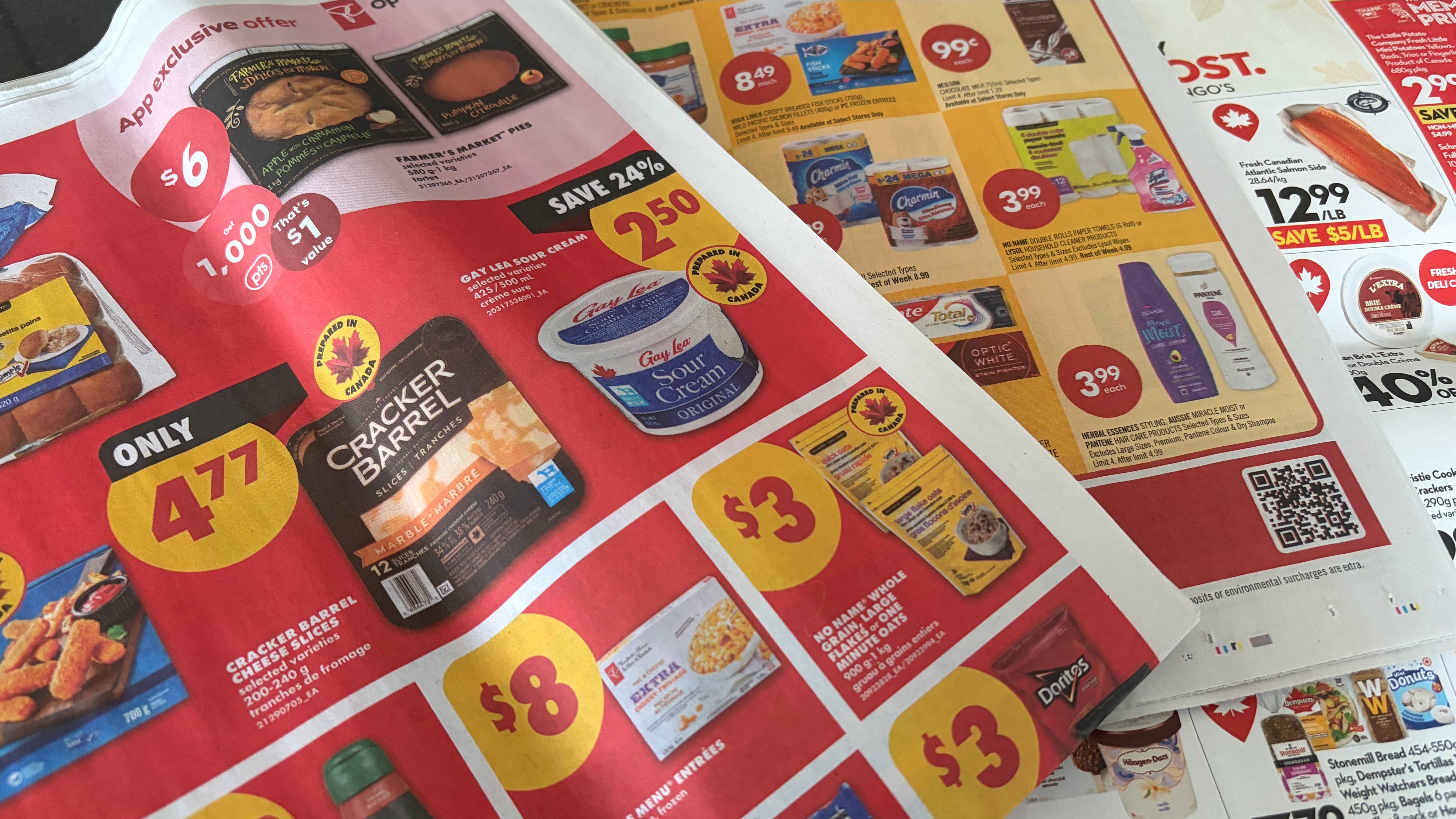
Have you ever seen a food item advertised in a flyer for one price, only to then see that same product selling for less at another store, or even in the one that offered the promotion in the first place?
That may be a phenomenon known as minimum advertised pricing – a situation where a retailer isn’t allowed to promote a lower price than one that has been agreed upon, or that is being forced on them by a supplier.
Minimum advertising pricing may be anti-competitive and contributing to higher food prices by preventing retailers from promoting better deals, which is why the Competition Bureau has launched an investigation into it.
Acting Commissioner of Competition Jeanne Pratt joined us last week to field some questions about minimum advertising pricing and its potential role in groceries, as well as other markets. Here’s an edited version of that conversation:
How do you define minimum advertised pricing and how can it be harmful?
Minimum advertised pricing policies restrict the ability of a store to advertise discounted prices, so that makes it more difficult for consumers who in the grocery industry use flyers, social media and a lot of other advertising to decide where they’re going to put their demand.
If a store can’t advertise that lower price, even though they might be able to offer it, we’re concerned that that will disincentivize that retailer from offering the lower price in the first place because they can’t use it to attract that demand.
Are these sorts of agreements typically imposed by the suppliers or do some of the larger retailers also have the ability to require them? How does this generally work?
That’s another question we’re looking to examine in depth. We’re aware that in some cases they can be imposed by suppliers or processors, but we’re also aware that they may be the subject of agreement between a manufacturer and a retailer. We really do want to want to see what are all the permutations of these over what products in the grocery store and who stands to gain and who stands to lose, but also how does that focus our attention on how that can impact the competitive process.
And this is happening, right? Just the other day I was in the market for a big can of powdered iced tea and I saw online that Walmart and No Frills were selling it for like $17 or $18, but Costco had it for $16. So I went to Costco and then they actually had it there for only $8. There could be many reasons for that, but does that hint at what we’re talking about here?
Yes, although I would say what we’re concerned about is that these minimum advertised pricings might actually disincentivize you getting that $8 price in the first place. That’s great that you were able to get an even lower price but you may not have gone to that store if it wasn’t advertised at the 16 bucks, right? So you may have missed out on that deal.
We’re investigating. We haven’t made any any findings, but it does lead to questions about whether that practice could soften competition between retailers because a lot of discounters, if they can’t advertise the price, they may not offer a lower price and that means that consumers are losing out on discounts and it means that we may be seeing that there’s less of an incentive to offer that lower price than the softening between retailers in terms of price competition overall.
The point of this really is to find out what’s going on. Find out how widespread this practice is, how many grocery products are covered by this practice and who may or may not be benefitting from these policies.
We also want to look into what the rationale for these policies is in the retail grocery industry. We do see these types of minimum advertised pricing practises as justifiable in cases where you might be buying really specialized photography equipment or stereo equipment or something where the manufacturer actually has to make an investment in training staff and making promotional products. That minimum advertised price may actually be justifiable where they have to support a level of service and training but we don’t see that kind of rationale applying to food in the grocery store.
Are there any other reasons why you’re focusing on groceries? The Bureau recently got a bunch of extra funding specifically to look at competition issues in the grocery sector – is that part of it?
You may have noticed over the last few months that the Bureau’s been focused on food and that’s really because Canadians are facing significant affordability challenges in food. There may be a number of factors that are contributing to that, but we want to make sure that competition is doing its job to ease affordability pressures.
That’s why we’ve done things like our study on “behind the price tag,” because we recognize that the cost of food and the price of food starts much further up in the supply chain than what’s reflected at the checkout. We’re doing that work to see if all along the food supply chain, are there areas where competition isn’t working well or are there barriers to competition working well?
You may have also noticed we took action on property controls, which was another barrier to competition in the grocery sector that we identified. I don’t think it’s any secret, it’s a priority for us because it’s a priority for Canadians and and we want to make sure we’re doing everything we can to ease those affordability pressures by doing our jobs to make sure competition can do its job to offer the benefits, which is lower prices, better quality and some innovation along the way.
Some independent grocers are concerned about this investigation. They figure that if these pricing agreements are banned, it’ll actually benefit the large retailers as they’ll be able to advertise prices that the smaller guys can’t match. How much of that are you taking under consideration?
As noted, we’re looking for information, so we haven’t made any findings. We really want to get information from everyone. But I would say too that our job is not to protect independent competitors, our job is to protect the competitive process and make sure that it’s working well and the benefits flow through to the consumer. This is exactly the kind of information we’re seeking to collect so that we can understand why these policies may exist, how widespread they are, who benefits and whether and to what extent they may be softening competition in retail grocery prices.
Is there a timeline on this investigation?
It’s a priority for us in our annual plan. Anything related to food affordability is going to be a strategic priority for our organization so we are going to try and go as quickly as we can. That being said, it is an investigation and it will depend on how the investigation unfolds and what pace the facts come in.
🎧 ON THE PODCAST THIS WEEK:
THE TICKETMASTER OF CAMPING THAT’S MAKING MILLIONS
Writer Cameron Fenton takes us behind the scenes of Camis Inc., the U.S.-owned company that dominates campite reservations in Canada
🥊 COMPETITION
A little known but potentially important piece of legislation is currently winding its way through the Standing Senate Committee on Banking, Commerce and the Economy. Senators and witnesses last week debated Bill S-239, or the “Canadian Prosperity Act,” which seeks to make federal and provincial governments answerable to recommendations put forward in industry inquiries conducted by the Competition Bureau.
As the Bureau notes in its submission to the committee, “there is no requirement for governments or regulators to respond to recommendations arising from these studies, leaving uncertainty about whether recommendations have been considered or why they may not have been pursued.”
A case in point was the Bureau’s first such inquiry last year into the airline industry, which featured 10 recommendations including encouraging new airlines to enter the market by removing barriers that limit smaller airports from competing with major hubs, requiring the publication of deeper industry data, and lowering foreign ownership restrictions on airlines. As we noted here back in November, that report seems to have been ignored by the government.
Bill S-239, sponsored by Senator Marty Klyne, would require a federal institution to respond to such recommendations within 120 days of their publication, while provincial counterparts would have the option of responding – though the competition commissioner could publicly note if no response was received.
The bill has passed through two readings at the Senate and continues to be considered in committee.
🛒 GROCERIES & RETAIL

Few things get people madder than messing with the price of their hamburgers. Just days after Reuters reported that MCDONALD’S was using surveillance pricing to charge customers differently - and the company denying it – a class-action lawsuit has been filed in Chicago.
The lawsuit, filed on Oct. 2, alleges that the burger chain is breaking the law by allowing independent franchise locations to swap non-public price and sales data.
“McDonald’s has built and for years deployed its own information-sharing pricing platform, which draws on data from its millions of daily transactions to set menu prices across thousands of U.S. restaurants,” the filing reads. “The result is algorithmic price-fixing aimed at customers who are already stretched thin.”
As with its quick rebuttal of the Reuters article, McDonald’s swiftly responded to the suit by saying it does not use AI to set menu prices. “Optional tools are available to franchisees to help them make the best decisions for their businesses and customers, but these tools do not automate, coordinate or fix pricing in any way,” the company said.
Speaking of the quick-serve food market, STARBUCKS is reportedly exploring a takeover of CHIPOTLE. The Financial Times reported on Thursday that the coffee giant is looking to combine forces with the burrito purveyor in an attempt to shore up profitability at both businesses. The connective tissue in such a deal would be Brian Niccol, who left Chipotle to take the chief executive job at Starbucks two years ago. Starbucks didn’t deny the report on Friday, but said it was focused on executing a turnaround strategy. The coffee chain has more than 41,000 locations worldwide with more than 1,400 of those in Canada, while Chipotle has more than 4,000 globally, including about 80 here.
The Competition Bureau scored a big win last week with NORTERA announcing it was scrapping a deal to acquire canned and vegetable food brands from B&G FOODS. The Bureau this summer filed an official challenge of the Quebec-based company’s planned purchase of the Green Giant and Le Sieur brands from New Jersey-based B&G, saying it was a “merger to monopoly” that would lead to higher prices for consumers. Nortera, which already owns the Del Monte and Arctic Gardens brands, said it needed the deal to protect its business from cheaper foreign imports. For more on this, check out the “Coming Up” section below.
The Weston family, owners of LOBLAW and SHOPPERS DRUG MART, is expanding its retail empire into the United Kingdom with the purchase of pharmacy chain BOOTS. The $12.7-billion deal will give the family’s holding company, Wittington Investments, approximately 1,800 stores in the U.K. and Ireland, the No7 beauty brand and Boots’ franchise arm in Thailand. The deal is being backed by investment firm FAIRFAX, which owns SPORTING LIFE and SLEEP COUNTRY, which itself expanded into the United States this summer by acquiring retailer SLEEP NUMBER. The Boots purchase marks the Westons’ return to the U.K. after selling off the Selfridges department store chain in 2022.
🛢️ RESOURCES
Another week, another flurry of mergers-and-acquisition activity in Canada’s resource sector. First up last Monday was CENOVUS announcing a $5.7-billion acquisition of ATHABASCA OIL, a deal the companies say has been sped up by several moves by the federal government. Among those was the feds designating a new oil pipeline from Alberta to British Columbia as the first national interest project, as well as the recently announced productivity mega-deduction that allows firms to write off up to two-thirds of capital investments. Cenovus believes the new measures will allow it to nearly triple Athabasca’s current oilsands production of 40,000 barrels a day by 2032.
Over on the other side of the country, SUNCOR also on Monday announced that it is selling its stakes in three Newfoundland and Labrador offshore oil projects to U.K.-based ITHACA ENERGY. Calgary-based Suncor says the deal for its 48-per-cent interest in Terra Nova, 40-per-cent stake in White Rose and 38.6-per-cent share of West White Rose is worth $1.2 billion plus an additional contingent payment of $350 million, based on future oil prices. The company says that despite the sale, it is keeping its stakes in the Hibernia and Hebron projects near Newfoundland and Labrador.
And rounding out the resource news, Halifax-based EMERA and Calgary-based CANADIAN UTILITIES on Tuesday announced that they were merging to form a new energy “powerhouse.” The new firm will be worth $72 billion and rank among North America’s largest utilities, setting them up to better compete with other, similarly consolidating companies, according to the executives who announced the deal. But some observers aren’t so sure, with The Globe and Mail’s analysis pointing out that the two firms’ main operations – in Florida and Alberta, respectively – don’t have a lot in common. “Is bigger actually better?” the paper asks. “So far, the answer’s pretty murky.”
🕺 ENTERTAINMENT
Newly minted entertainment megalith SKYDANCE, of PARAMOUNT and WARNER BROS. fame, is going to be laying off employees soon, according to a company memo obtained by Variety. Chairman and chief executive David Ellison and co-CEO Ynon Kriez informed staff of the impending cuts in a memo sent out on Tuesday, just after the companies closed their $111-billion (U.S.) merger. “Integrating two companies will bring change, including difficult decisions that affect our workforce,” they said in the memo. “We are committed to handling this process thoughtfully and respectfully.” The new company is carrying approximately $80 billion in debt and executives say they want to achieve $6 billion in cost savings within the first three years.
🚨 COMING UP
We started this newsletter with the current acting Competition Commissioner and we’re ending with one of the Bureau’s former bosses. Former commissioner JOHN PECMAN joins the Do Not Pass Go podcast this Thursday to talk about how Nortera’s attempt to buy Green Giant was an example of increasingly conflicting priorities between Canada’s competition watchdog and the federal government. Canada would be better served by closer co-ordination between the two, he says, and by giving government the right to veto Bureau challenges when it comes to sensitive sectors.
Regarding the US media giants merging. I wonder how many reporters they will layoff?
That could have a profound effect on democracy in the US and have a rollover effects in Canada. When the elephant rolls over we might get crush in Canada.
What happens in US business and government usually has effects that impact Canadians.
If there are no reporters will a falling tree in the forest get reported?