


Despite admitting to false advertising and agreeing to pay a $1.2 million fine last week, Canadian Tire is continuing to circulate flyers listing high regular prices for products alongside lower, supposed sale prices – including in the same Montreal area where the retailer got busted by Quebec’s consumer protection agency.
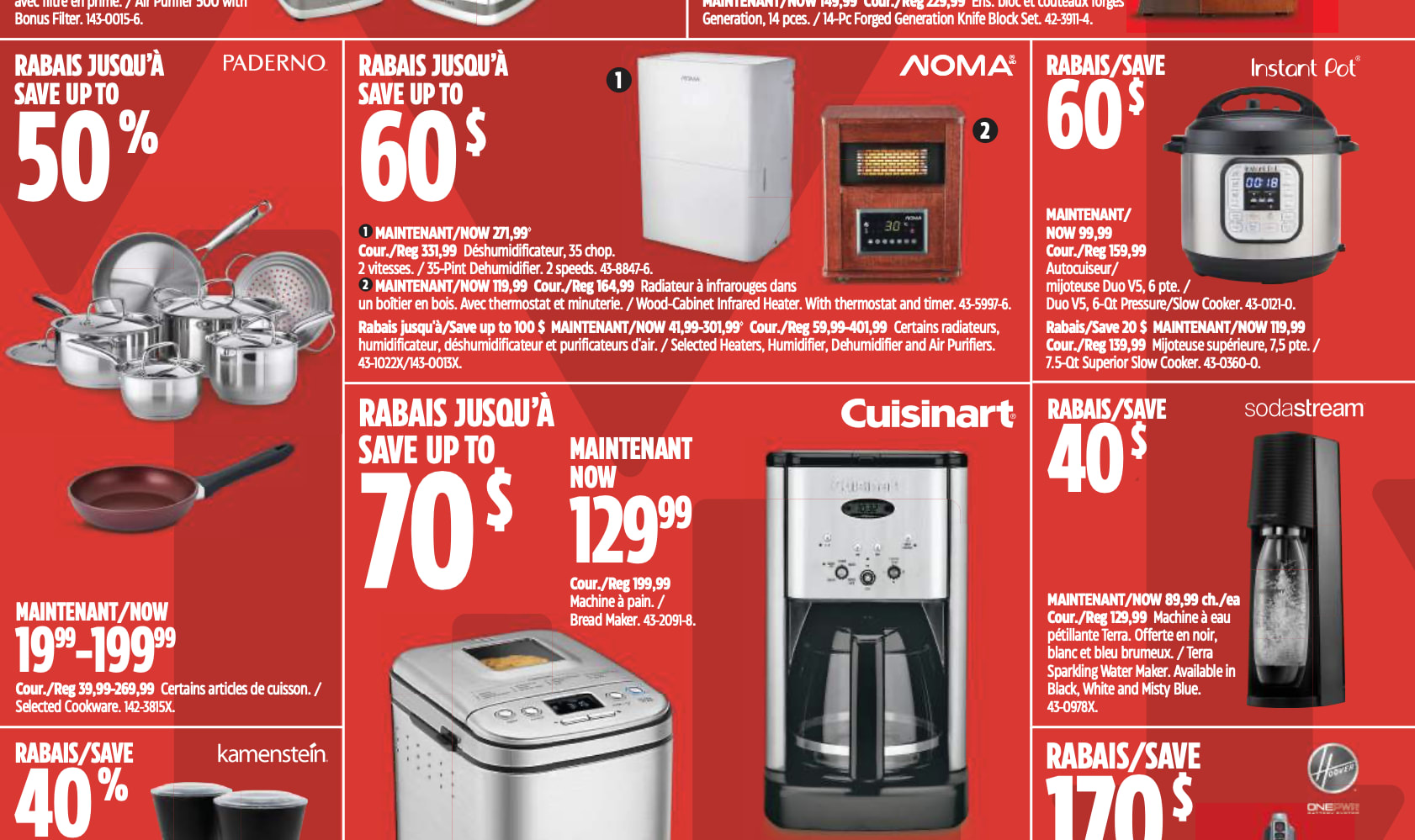
The front page of the company’s flyer for the week of Feb. 5 to Feb. 11 for the Montreal suburb of Repentigny, for example, lists a Hoover vacuum at a regular price of $269.99, with a sale price of $149.99, while a set of The Rock pots are on sale for $99.99 with a regular price of $149.99.
Virtually every product in the flyer is listed at an apparent discount, including Dewalt cordless drills and Henckels knife sets – two products similar to those at the centre of the investigation by the province’s Office de la protection du consommateur (OPC) that led to last week’s settlement.
The Repentigny advertisement isn’t an exception but rather the norm, with Canadian Tire flyers across Canada typically featuring high regular prices for products along with lower discount prices. And it isn’t just Canadian Tire – this kind of “high-low” pricing is fairly standard among retailers, and it isn’t necessarily illegal.
Where it runs afoul of the law both in Quebec and in the rest of Canada is when a retailer sells the product at a discount more often than not, showing that the supposed full regular price is anything but – and thus a case of false advertising.
Courts have previously found this conduct to be anti-competitive as it disadvantages honest merchants, who then come under pressure to also misrepresent their own prices. (Story continues below)
Canadian Tire Pleads Guilty To False Advertising

FEB. 6 UPDATE: Canadian Tire pleaded guilty to the charges described below in Quebec court and will pay a $1.2 million fine, plus legal costs.
The problem is that someone has to track prices to prove that they are falsely high, which is what the OPC did in the Canadian Tire case. To obtain a guilty plea, the agency investigated the retailer’s prices on a handful of products at Montreal-area stores over a six-month period in 2021, resulting in 74 counts of violating Quebec’s Consumer Protection Act.
Both the Directeur des poursuites criminelles et pénales, the province’s prosecutor, and the OPC declined a request to provide a copy of the settlement. OPC spokesperson Charles Tanguay said that everything related to the negotiations that led to the plea is “strictly confidential” and that he cannot comment on the company’s current advertising and discount practices.
“Let’s say that, in general, after a merchant has been convicted, the [OPC] conducts verifications to ensure that the convicted merchant has changed his practices and complies with the law,” he added.
Canadian Tire did not respond to a query on whether the settlement will result in any changes to its advertising.
Retail experts say the Quebec settlement is a financial pittance to the Toronto-based company, the largest non-grocery bricks-and-mortar retailer in Canada, with revenue of $16.3 billion in 2024.
Aside from perhaps being more careful to technically stay within the law, large retailers are likely to continue with high-low advertising strategies because they work – they get consumers to buy products they otherwise might not by creating the impression that they’re getting a deal.
“A lot of people don’t bother to check prices, they don’t spend time to do their homework,” said David Soberman, a professor and the Canadian National Chair of Strategic Marketing at the University of Toronto. “A significant portion of consumers fall into that category, so that’s why the retailers do it.”
The Competition Bureau is currently investigating furniture retailers Leon’s and The Brick for similar advertising practices and fake urgency cues. In 2023, the federal agency came to a $3.25 million settlement with furniture retailer Dufresne Group in a similar case.
These cases, along with rampant algorithmic and personalized pricing online, are evidence that consumers are at a significant information disadvantage when it comes to virtually everything they buy, according to the Canadian Anti-Monopoly Project.
“Prices are becoming more opaque and dynamic, so we really need to lay down some guardrails on how people receive different prices,” says CAMP executive director Keldon Bester. “There’s no way it’s a fair playing field for the consumer.”
There are already a bunch of websites that track prices over time for various companies (we listed a few of them in your last post). It shouldn’t be hard to use that data and algorithmically determine if a retailer uses unfair pricing.
This would be a great side project for me if I didn’t already have a job, family and hobbies.