


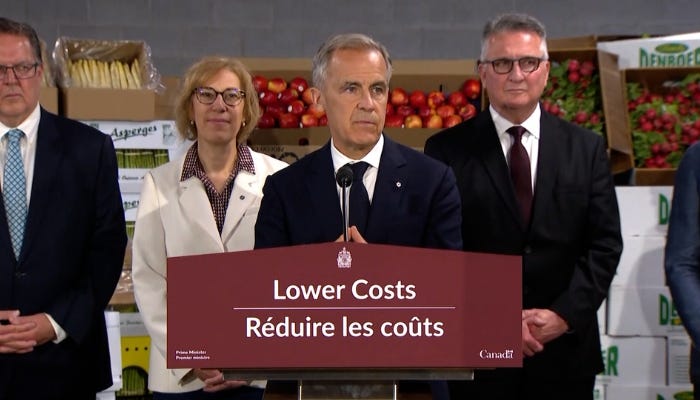
The federal government this week announced an amibitous $3.2 billion plan to bring grocery costs down by building new infrastructure and competition capacity into Canada’s food system.
The National Food Security Strategy, unveiled by Prime Minister Mark Carney Thursday in Toronto at the Ontario Food Terminal, aims to expand existing distribution facilities and create 20 to 40 new hubs across Canada to offer smaller grocery sellers “a viable alternative to major retail.”
“We are an agricultural superpower, yet for most Canadians, it doesn’t feel like that at the checkout counter,” Carney said. “We’re going to grow more at home, process more at home and feed more Canadians with Canadian food.”
The 10-year plan includes $1 billion for building and expanding food terminals and hubs and a $1-billion Agri-food Project Finance Fund that will provide seed financing for businesses to expand processing capacity. It also includes $750 million to expand year-round domestic production of fruits and vegetables through greenhouses, vertical farms and other indoor growing operations.
Notably, the Competition Bureau and Competition Tribunal are getting $130 million in new funding to investigate and combat anti-competitive business practices in the food industry. That new funding comes as a surprise to some, given that the government initiated 24 job cuts or five per cent of the Bureau’s workforce back in January.
Those cuts are coming largely from support staff, while the new funding looks to be going toward enforcement, according to a source close to the situation.
Consumer advocates are cheering the food strategy as it addresses several layers of competitive problems in the Canadian industry.
“These are important investments in the future of grocery competition in Canada and we’re very glad to see them,” says Keldon Bester, executive director of the Canadian Anti-Monopoly Project.
“Funding to expand the infrastructure that allows independent grocers to compete, as well as additional resources for the Competition Bureau to protect fair competition in the grocery market are both welcome developments.”
Carney is, however, taking some heat over comments he made at the Thursday press conference in regards to household spending on groceries. While noting that grocery prices have risen 35 per cent since 2019, he said the average family of four spends $10,000 a year on groceries or $800 a month.
But, as Dalhousie University food researcher Sylvain Charlebois notes, that number is closer to $17,572, or $1,464 per month.
Writing on his Substack, Charlebois also points out that the government’s announcement isn’t so much a strategy as a “collection of investments,” with little explanation of where all the funding is going to come from.
“The government’s plan is a positive step. It demonstrates that Ottawa is paying attention to food systems in a way it has not for decades,” he says. “But food security cannot be purchased through government spending alone. It is earned through investment, innovation, productivity, and competitiveness.”
Aaron Vansintjan, policy manager at Food Secure Canada, is also cautious in his optimism about the government’s plan. While the development of new food distribution hubs that provide competitive alternatives for smaller grocers – including emerging municipally owned stores – is a positive step forward, he doesn’t see anything in the plan that will prevent profiteering by Canada’s large grocers.
The strategy also isn’t truly national because it doesn’t include income supports for especially needy families, including those with disabilities or children, or provisions for northern Canada, where food prices are exceptionally high.
“It’s a strategy that sees food as a subject of national security, but it doesn’t solve food insecurity,” he says. “I’m happy, but it’s half-assed.”
🎧 ON THE PODCAST THIS WEEK:
The Luxury of Economic Dissent

One question we often ask in these parts is what can the average person do about monopolies and oligopolies? The answers vary depending on the situation, ranging from boycotts of products and services to shareholder activism and even political action.
🏈 SPORTS & LEISURE
The World Cup is here and with it, continuing sky-high ticket prices. Attempting to get ahead of the, er, game, Ontario this week boosted the penalty for reselling tickets above face value to $25,000 from the previous $10,000, and yet… no one seems to be getting busted, still.
Ontario has also added STUBHUB and SEATGEEK to its Consumer Beware List, which names and shames companies that have not responded after two notifications of consumer complaints or that have been convicted in relation to the Consumer Protection Act or other acts of the ministry.
For their part, the companies say the province has not given them guidance on how they’re supposed to verify the face value of tickets sold on their sites.
“Over the past seven weeks, we have been seeking guidance on key details that are fundamental to compliance, such as what constitutes acceptable proof of a ticket’s original price,” StubHub said on Thursday. “We received partial answers to these questions today and are continuing to work with the Ministry toward full compliance.”
For more on this contentious issue, I reached out to Florian Ederer, a professor of markets, public policy and law at Boston University and an expert on competition and sports ticket resales. Here’s that conversation, edited for length:
What’s the big idea behind banning resale of tickets at a profit?
As soon as you have a very active resale market, you get big differences between what tickets are worth there and what they’re actually selling for in the primary market, and that creates rents.
Once you have these rents, there are incentives for resellers to enter and flood the primary market with ticket requests, which means fans don’t get to buy those tickets and have to go to the resale market.
The resale market often gets the price right and you just have to pay higher prices there. The benefit of buying in a primary market is that these tickets are potentially underpriced, but there’s going to be lots of people who understand that, and therefore you may not get a ticket in the first place.
The resale market creates a better allocation of tickets to those who value them the most, or have the highest willingness to pay.
That’s great if the only objective is to allocate the tickets to the people who are willing to pay the most, but it’s not particularly good if you’re also thinking that there may be other criteria for allocating tickets. You may want tickets to go to real fans or fans that create all the atmosphere in a stadium, or you want them to go to the most dedicated fans of an artist. Once you allow that resale market, it becomes much harder to pursue that second objective.
Even the most deserving fans, when they get tickets for $300 but can resell them for $3,000, might say, “Well, should I really go to the stadium or should I just pocket the profit?”
The other reason you might want to ban resale is that you’re concerned that fans are getting exploited by resellers or the resale market. That’s only the case if there is really a massive underpricing in the primary sales market to begin with.
That hasn’t been the case with FIFA because FIFA has been very aggressive with very high ticket prices in the primary market, including to some games that really do not have all that much demand and willingness to pay.
Going back to those two objectives, different types of events fall on different parts of the spectrum. For the World Cup, there are a lot of people who think the primary objective should not be profit maximization. In fact, FIFA is not a for-profit organization so therefore shouldn’t be maximizing profits in the first place.
If you ban resale entirely, the only people who will want to buy tickets are the people who actually will go to those games, and so then you’re really favouring that second objective, and that’s how it was for a long time. It’s also not too difficult logistically because, if you think about, airlines – there’s also no resale there.
If I buy a ticket on an airline, I can’t just turn around and say, “Oh, well, the flight’s more expensive now, I’m going to resell my ticket to somebody else.” Same thing with ski ticket passes, you can’t just transfer them.
But somehow with concert and sports tickets, we have decided that no, they should be transferable, and that of course leads to a real commercialization and financialization of that.
If a jurisdiction moves to ban the resale of tickets at a profit, what should the results of that be, in theory?
In theory, it should eliminate that resale market entirely. What is more likely to actually happen is that the resale market then becomes much more secret – we’re going into a black market where people are literally standing outside the arena or stadium and they’re just selling the tickets there.
It will also likely decrease the profits of the original seller because now you’ve basically shrunk the demand to only those people who really want to go to the game.
You might say that banning the resale market shouldn’t make any difference to the original seller, right? They would just price tickets accordingly, whatever the market price was before and then do the same thing without the resale market, but that usually does not happen.
Instead, what really does happen is we get a massive reduction in the profits of the resellers and it puts a lot less pressure of finding tickets in the primary market in the first place.
Some people say this is all just supply and demand and should be left alone. How much of it is real demand and how much is just profit seeking? And the $3,000 example you mentioned earlier – if left alone, does that shift sports and concerts to where it’s only rich people going?
Yeah, it is. Imagine if we’re selling tickets at $300, there’s no resale and there’s tons of demand. Only 10 per cent of people will get tickets who actually want them at $300, so you basically turn it into a lottery. In some sense a lottery is more egalitarian, but it doesn’t mean that tickets go to the people who value them the most.
If you have a discriminatory resale market, that always gives tickets to the people who are willing to pay the most. It’s great for whoever is selling them and for everybody who has a high willingness to pay, but it is a much less egalitarian.
Willingness to pay is not necessarily the same thing as the deservingness of going to a game and so that’s obviously tricky.
Some season ticket holders aren’t happy with Ontario’s ban because they say it makes the product less appealing if they can’t recoup some of their expenditure. Does that argument have weight?
Yeah I think that’s absolutely true, and one could say maybe a better policy is we should differentiate between where we ban resale. Maybe we should ban resale on extremely high demand events and maybe less so on season tickets.
But whenever you allow resale, you’re creating this market that is basically pure rent-seeking. It’s just people getting in there to get a piece of that difference between the face value price and the market price.
We might say as a society: Is that really a valuable use of these people’s time? It’s good that they’re generating all this money, but maybe these resellers should be doing other more interesting jobs than transferring money from sellers or consumers to themselves. You could say that there’s just zero societal gain from all of this.
Of course, the resellers might push back and say, “Well, we allow this market to occur, and then that allows better allocation of tickets and better matching of tickets to those who actually value them the most,” and so on, but in essence it’s mostly just people out there trying to get a piece of those rents.
How difficult are such bans to enforce – it appears that Ontario isn’t doing so – and what happens when there’s no enforcement?
We don’t have much experience with real strong enforcement of these bans. We used to have these anti-resale laws in the United States, but it was always looked upon as a cavalier thing. Like, if people do it, it’s bad and they get told off, but nobody ever goes to jail or gets punished.
Once the third-party resale platforms arrived on a big online basis, everybody realized, well, there’s no way of stopping this unless we really massively enforce this and hand out fines. And basically, lawmakers then threw their hands up in the air and said, “No, we’re not going to do this.” And there’s also tons of lobbying from those resale platforms because it’s a huge market.
So do we actually know what happens if one were to enforce these things? No, because it’s never been done. Nobody has really been busted.
It’s not that difficult to enforce, if you were just required to show ID that’s matched to your ticket. Think about airlines – you can’t resell the airline tickets because you have to show up there with your ID.
Here in Ontario, StubHub says the province hasn’t provided guidance on how to prove face value of tickets. With dynamic pricing, it’s actually hard to actually tell what face value is. Is this a legitimate concern from the company?
It’s very easy to just say, “All the tickets are getting sold at $150.” But here, not only do different categories have different prices, but even within categories over time you have price variation. I can see how that would make the enforcement even harder to do.
But again, it’s not that hard. All you need to do is show your original receipt of when you first bought those tickets and what the face value was. I don’t think it’s that hard because they don’t want that law in there in the first place.
📱 TELECOM
Last month, BELL got smacked down by the CRTC for attempting to get around new rules – which take effect today – that ban service activation and cancellation fees. This week, it was TELUS’s turn. The regulator sent the company a letter urging it to back off a plan to introduce a new charge of up to $25 for new SIM cards, including electronic eSIMs. Just as with Bell last month introducing a $40 “device handling” fee, the CRTC is taking a dim view of Telus’s move. “A SIM card or eSIM is required for the delivery of the wireless service customers are purchasing,” wrote Scott Hutton, vice-president of consumer, analytics and strategy at the regulator. “It would not appear that the SIM purchase fee falls under the exemption considered by the Commission for optional services and products. A fee associated with providing a SIM card or eSIM may be considered to be an activation fee that is prohibited under… the [Telecommunications] Act.” Telus may be sticking with its guns, however, telling the Canadian Press that SIM cards are separate hardware and that eSIMs require “real backend work even though there’s no physical card.” With the now-banned activation fees reaching as high as $80 and cancellation fees amounting to what are likely not insubstantial revenues for the telcos, it’s unlikely they’re going to go down without a fight on this one. The rules, by the way, were made part of the Telecommunications Act in order to eliminate fees that discourage customers from switching providers.
The CRTC has launched another round of information gathering on cable wholesale internet pricing, which is the access cost that smaller providers such as TEKSAVVY and EXECULINK pay large companies including ROGERS and VIDEOTRON to use parts of of their networks to deliver services to customers. In a letter sent to the relevant parties this week, the regulator asked large network owners to resubmit their wholesale cost estimates, since the existing studies they filed several year ago may now be out of date. “Commission staff notes that the cable carriers submitted their initial… cost studies between June 2023 and April 2024,” the letter says. “However, Commission staff is concerned that the costing information currently on record may no longer reflect the prospective incremental costs of providing these services.” That very much sounds like an invitation to the larger companies to raise their stated costs, which means that wholesale-based ISPs may end up paying them more. That can, in turn, be bad news for consumers, as indie ISPs discipline the prices that large cable companies can charge their own customers. And, according to CRTC figures, up to 40 per cent of Canadian households are still connecting to the internet via cable connections, despite the rise of fibre. What’s potentially more concerning is that the CRTC’s letter is effectively an admission that the regulator has been taking too long to settle this important matter. “It’s the longest-ever process on a mandate to do things faster,” says one ISP executive. “That is troubling.”
The CRTC has also launched a public consultation on harmonizing the disparate consumer protection codes it oversees. Currently, the regulator maintains separate codes of conducts for internet, cellphone, home phone and television services, and is looking to unite them into one that would be “easier to understand, reduce billing surprises, and help Canadians make informed choices about their communications services” and “create greater consistency for service providers, helping reduce complexity and resolve customer complaints faster.” The CRTC is accepting comments from the public until Aug. 11.
In case you missed it, not only are telecom complaints out of control – big telcos aren’t properly informing customers about their options when it comes to service and billing disputes:

✈️ AIRLINES
The federal government this week said it would offer loans to Canada’s airlines to help cover the elevated cost of fuel resulting from the war in Iran. One might expect the companies to welcome this help, but not WESTJET – the country’s second-largest airline “strongly opposes” the offer. “The government faces a choice: continue with costly and market distorting subsidies or build a sustainable future for Canadian aviation,” a spokesperson told CTV. “We’ve seen where this path leads. In 2025 alone, taxpayers lost around $400 million in COVID-19-related airline loans that were forgiven by the federal government. With this, they have been turned into direct taxpayer subsidies to some airlines.” Passenger rights activist Gabor Lukacs doesn’t necessarily disagree, telling Do Not Pass Go that these sorts of subsidies are effectively rewarding airlines that have failed to properly hedge against such risks. “Their execs can have a confidence that the government will bail them out anyway because they are ‘too big to fail,’” he says. “This is not so say that we should necessarily let these airlines go bankrupt per se, however, the current owners and not taxpayers should be bearing the financial consequences of their lack of responsible financial planning and management.” FLAIR, PORTER and AIR TRANSAT did indeed welcome the loan news, while AIR CANADA spokesman Peter Fitzpatrick tells us the company has a “very strong balance sheet built in anticipation of events such as the recent spike in fuel prices and we are able to adapt in response and manage this situation ourselves.”
🕺 ENTERTAINMENT & MEDIA
Related to the item on concert and sports prices above, Business Insider this week published a piece that effectively lays out the realities of surveillance pricing. Staff at the publication tried to buy the exact same ticket at the exact same time to a recent Yankees-Red Sox baseball game on STUBHUB, only to get five different prices. The $55 pricing range between cheapest and most expensive was largely due to differences in the fees being added to the base ticket, with one staffer on a desktop getting $60 tacked on while another in a different city got only $28. “For consumers, the modern American shopping experience is a constant battle that no one signed up for and no one can win,” the piece concludes.
And on the topic of surveillance pricing, the WASHINGTON POST is being sued by subscribers for price increases that are based on personal information. Subscribers started seeing renewal notifications starting in March, with offers stating that “this price was set by an algorithm using your personal data.” The suit, filed by Clarkson Law Firm, is seeking class-action status.
The ongoing PARAMOUNT acquisition of WARNER BROS. DISCOVERY saga continues to turn up new twists and turns, with the company this week accusing NETFLIX of waging a “scorched earth” campaign against it. Paramount says the streaming giant is trying to turn regulators and other stakeholders against it after the company beat out Netflix with its bid to acquire Warner Bros. For its part, Netflix says the accusation is “absurd.” Meanwhile, add the U.K. competition watchdog to the list of entities opposing the $110 billion (U.S.) merger, with the Competition and Markets Authority opening an investigation into the deal that it believes will result in a substantial lessening of competition. Australia and New Zealand, however, are cool with it, with regulators there giving the merger the green light.