



It was a bad week for Air Canada, starting with the horrendous news of the crash at New York’s Laguardia Airport that killed two pilots and injured many passengers on board one of the airline’s flights from Montreal.
While the investigation into causes is still ongoing, early accounts suggest that traffic controllers at the airport had trouble tracking the fire truck that collided with the plane, with fingers also being pointed at the deficiency of staff in general.
The situation took an unexpected turn on Monday after Air Canada chief executive Michael Rousseau released a video expressing his condolences to the pilots’ families. The video was in English only, which kicked off a fresh furor over the Montreal-based airline CEO’s inability to speak French.
Rousseau has repeatedly drawn fire for his lack of bilingualism while heading Canada’s national carrier. In 2021, he sparked criticism for saying that he had lived in Montreal for 14 years without having to learn French, after which he promised to take lessons. He has repeatedly been called by the federal Transport Committee to answer for the issue.
Quebec’s Justice Minister Simon Jolin-Barrette said this week’s video proves the airline CEO is a “repeat offender.” He was joined by provincial politicians from various parties in his call for Rousseau’s resignation. Even Prime Minister Mark Carney chimed in, saying that he was “very disappointed” with Rousseau’s mono-lingual apology and that it “lacked compassion.”
Rousseau responded with a statement in which he apologized for his gaffe diverting attention away from the crash itself and the grief of those involved.
The language issue is of key concern to culture hawks, but critics are finding themselves agreeing with Rousseau in a roundabout way – that it’s a distraction from the crash, but also the government’s ongoing refusal to address the airline competition problem.
“This is identity- and token-politics, a good way to divert attention from the airlines shortchanging passengers and sabotaging the [Air Passenger Protection Regulations],” air rights advocate Gabor Lukacs tells Do Not Pass Go, referring to recent revelations regarding the Carney government’s efforts to help airlines avoid paying for a complaints system.
Rather than focusing on language issues, he says, the government should be directing its energy to resolving the growing backlog of passenger complaints – which is at least 88,000 deep, with many taking years to resolve.
Those complaints are multiplying rapidly, with new issues continually arising – such as the revelation this week that Flair Airlines’ luggage measurement bins at airports were actually smaller than those listed online.
“It is ridiculous that the PM would comment on this. Yes, historically, Air Canada is bound by the Official Languages Act. Yes, it would have been nice if the CEO had expressed condolences in French as a matter of courtesy and compassion,” Lukacs says. “But there was no legal obligation for him to do so and convening a committee meeting over this is a theatre. The MPs should spend their time on investigating how airlines disobey the law rather than this kind of symbolic stuff.”
🕺 ENTERTAINMENT & LEISURE
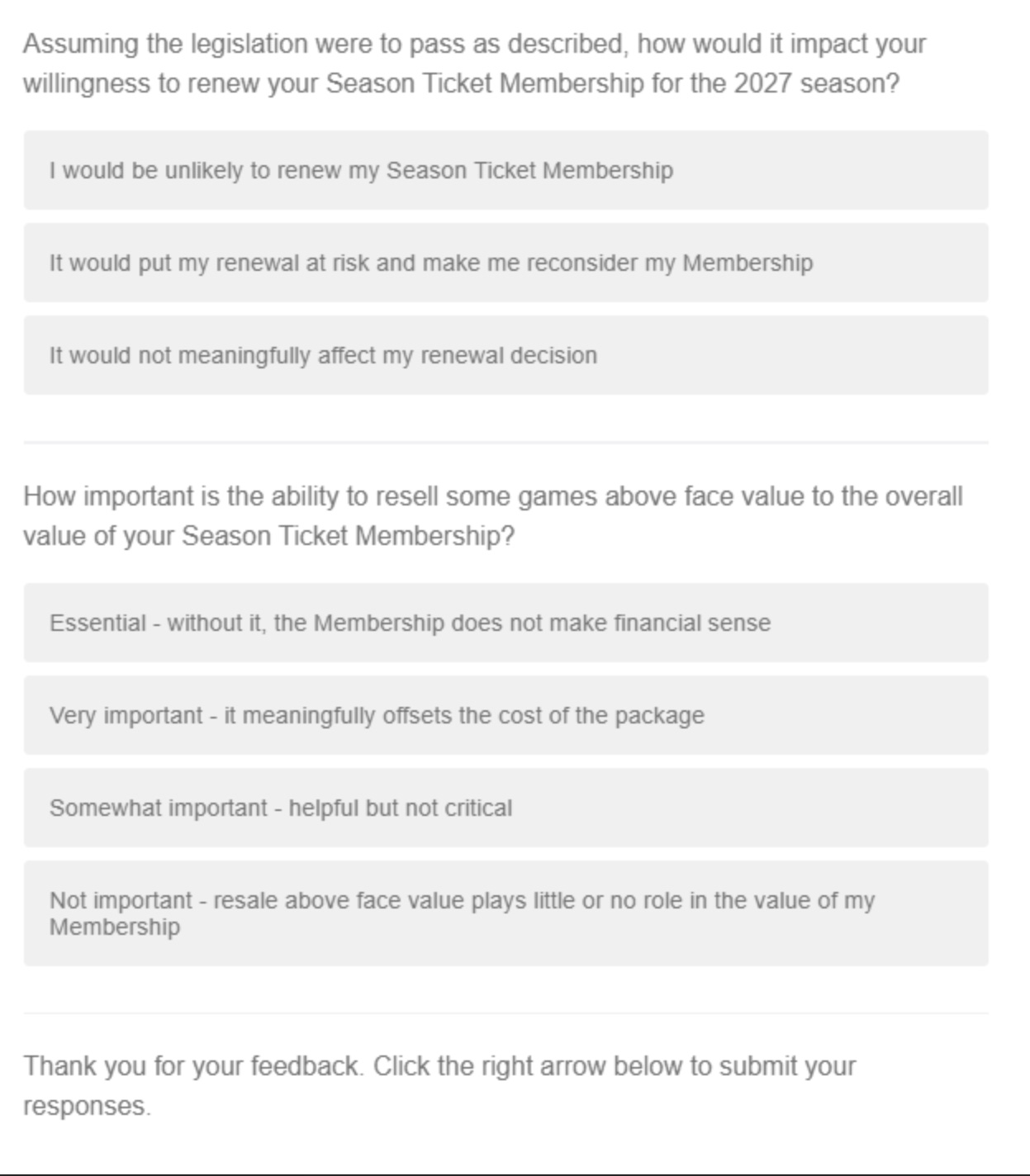
On a happier note, baseball season is here, woohoo! Things might be a little different this year as far as Blue Jays tickets go if Doug Ford follows through on his promise to ban scalping. The Ontario Premier, who scoffed at Jays’ sky-high playoff prices last fall, recently made headlines for saying that he plans to introduce laws that would make it illegal to re-sell event tickets through the likes of TICKETMASTER and STUBHUB for more than face value. The ROGERS’ owned Blue Jays have taken notice, sending out a survey to season ticket holders asking them how they feel about the proposed ban and whether it will affect their plans to renew. The survey tells recipients that Ford’s move would “limit their ability to offset the cost of an 81-game package by reselling games they cannot attend for more than original purchase price,” before asking “how important is the ability to resell some games above face value to the overall value of your season ticket membership?” Is this a step toward Rogers and the Blue Jays opposing the proposed ban?
Speaking of ROGERS and sports, The Globe and Mail has a great scoop on company scion and executive chairman Edward Rogers trying to get out of paying his MAPLE LEAF SPORTS ENTERTAINMENT partner Larry Tanenbaum for fees related to his late mother’s estate. Rogers is objecting to the $11 million in total compensation that Tanenbaum and two other executors are claiming for dealing with Loretta Anne Rogers’ estate, saying that his MLSE partner appears to have “delegated” his duties to his co-trustees. Tanenbaum’s company Kilmer Sports holds the remaining 25 per cent of MLSE, which owns the Toronto Maple Leafs, Raptors, Argos and TFC, among others, that Rogers does not control. As The Globe points out, the two men have often clashed, with this legal battle being the latest episode. Rogers is also angling to acquire Tananbaum’s remaining stake in MLSE.
The skiing and snowboarding season may be winding down, but the suing of resort operators is just getting underway. A new class action suit was filed in the U.S. this week against VAIL RESORTS and ALTERRA MOUNTAIN, both based in Colorado, for allegedly inflating lift-ticket prices through “anti-competitive bundling practices tied to their multi-mountain season passes.” The passes in question are Vail’s Epic and Alterra’s Ikon, which give users access to the companies’ respective resorts around the world and run from a few hundred dollars to nearly $2,000 depending on the number of days selected. The lawsuit alleges that resorts are jacking up the price of single-day tickets as a way to “coerce customers into buying their multi-mountain season pass offerings which [skiers] then view as more cost effective.” Vail owns more than 40 resorts in the United States, Australia, Switzerland and Canada, including Whistler Blackcomb. Alterra owns 18 properties in North America, including Blue Mountain in Ontario and Mont Tremblant in Quebec. Paul Pinchbeck, president of the Canadian Ski Council industry advocacy group, says the skiing and snowboarding market in Canada isn’t as concentrated as it is in the U.S., with Vail and Alterra owning only three of the 240 active ski areas here. Many Canadian resorts offer their own passes and work in collaboration with Vail and Alterra even if they aren’t officially under their respective ownership. “Connections to the mega passes allow partner ski areas to expand their market reach in a cost-effective manner with the goal of growing business in the destination ski market,” he tells Do Not Pass Go. “Canada’s ski areas continue to recognize that affordability is high on customer desires and will continue to create and offer new access products and options that are cheaper than the walk-up window pricing on a peak day.” Coincidentally, left-leaning news site Jacobin has a new feature on the “Big Ski” duopoly of Vail and Alterra, and how it’s leading to the decline of the sport. “Costs have gotten so bad that it seems like hardly anyone can afford to ski these days,” it says.
Not only does spring mean the end of skiing and the advent of baseball, it also brings the beginning of roller coaster season. As if to remind everyone of that, the Competition Bureau this week filed an amended application of its junk fee case against Canada’s Wonderland, the largest amusement park in Ontario. The Bureau is accusing the park’s owner, North Carolina-based SIX FLAGS, of advertising “unattainable” prices, since additional junk fees – such as a processing charge of up to $9.99 – are stacked on top of ticket purchases. The filing cites several “aggravating factors,” such as Wonderland being the only amusement park in Canada that continues to charge junk fees, Six Flags doing so despite the Bureau’s previously successful enforcement actions against rental car companies and most recently Cineplex for the same, not to mention related settlements with satellite and streaming radio providers. You can almost hear the exasperation coming through in the application: “Despite the information available, Wonderland engaged in and continues to engage in the conduct at issue.”
It’s not your imagination – streaming prices are rising, according to a new report by Canada’s Convergence Research. The 10 leading providers, which in Canada include NETFLIX, DISNEY+, AMAZON PRIME VIDEO and CRAVE, hiked prices by an average of 7 per cent last year, which follows an 8-per-cent increase in 2024. Those price increases are pushing consumers toward cheaper ad-supported packages, Convergence says, which is almost certainly the streaming companies’ strategy. Right on time, Netflix has announced another slew of prices hikes, though MobileSyrup reports that these aren’t necessarily applying to Canada.
In case you missed it, we broke the news here this week that the Competition Bureau is reviewing the $110-billion mega-merger between PARAMOUNT and WARNER BROS. With both companies having significant film and television production and streaming presences in Canada, the review might be expected, but questions abound over what the competition enforcement agency can do about it:

🛒 GROCERIES & RETAIL
City Councillors in TORONTO have voted overwhelmingly in favour of going ahead with a municipally owned grocery store pilot project, with a vision and strategy plan to be presented in the second quarter of 2027. The review will also consider what policy levers the city has to “prevent price gouging by grocery and other retailers, including ensuring retailers licensed by the City are transparent about rates and prices and disclose the use of consumers’ personal data and algorithmic pricing.”
A shout-out to The Peak this week for highlighting the rebound going on with independent bookstores in Canada, many of which have united under the booksellers.ca banner as an alternative to both AMAZON and INDIGO. The newsletter points out that the website, run by Les Librairies indépendantes du Québec, has expanded to eight more provinces to go with its English version launch. Indie stores are having something of a resurgence, with approximately 300 across Canada as of 2024. The website will allow these indie stores to ship books for cheaper and to offer a wider selection, according to The Peak.
💾 BIG TECH
A Los Angeles jury handed down a landmark ruling this week in finding GOOGLE’s YouTube and Facebook owner META guilty of cultivating social media addiction in kids. The court awarded a 20-year-old woman known as Kaley $6 million (U.S.) for mental health damages brought on by her addiction to the social media platforms. Mental health advocates are hailing the verdict as a huge win as it sets a precedent for hundreds of other similar cases currently winding through U.S. courts. Canada is seeing such cases as well, with a B.C. woman last month launching a similar lawsuit against Meta. The tech giants disagree with the findings in the U.S. and say they plan to appeal.
Mark Zuckerberg’s META is having a helluva bad week, with a New Mexico court also ordering the social media company to pay $375 million (U.S.) for misleading users over the safety of its platforms for children. A jury there found that the company, which also owns Instagram and WhatsApp, endangered kids by exposing them to sexually explicit material and contact with sexual predators. The company intends to appeal.
GOOGLE had some slightly better results, with a U.S. court this week throwing out an antitrust case brought by two publishers who alleged that the company has monopolized the online news market with its search business. Amit Mehta is the same judge who in 2024 ruled that Google was indeed a monopoly in search and online advertising. In this case, he found that the two publishers – Helena World Chronicle and Emmerich Newspapers – did not sufficiently prove that they had been harmed by the company’s actions in the search market.
🥊 COMPETITION
In case you missed it, recently retired Federal Court Chief Justice and Competition Tribunal head PAUL CRAMPTON joined the Do Not Pass Go podcast this week to discuss how recent law changes might affect future merger and abuse-of-dominance challenges in Canada:

🚨 COMING UP
Whether you’re an influencer, small business or large enterprise, it’s never a good idea to hitch your wagon too tightly to someone else’s train. Spencer Callaghan, director of brand communications for the CANADIAN INTERNET REGISTRATION AUTHORITY, joins the podcast on Monday to discuss the dangers of putting too much effort into platforms that can pull the rug out at any time and the importance of owning your online presence.