


Quick scheduling note: This newsletter isn’t actually late! Rather, I noticed that publishing news and other good stuff on Friday afternoons probably wasn’t the smartest thing from a timing perspective, so I’m moving it to Monday mornings as of today. And, to avoid cluttering your inbox on successive days, I’m shifting podcast publication to Thursdays. And now on to our regularly scheduled content…
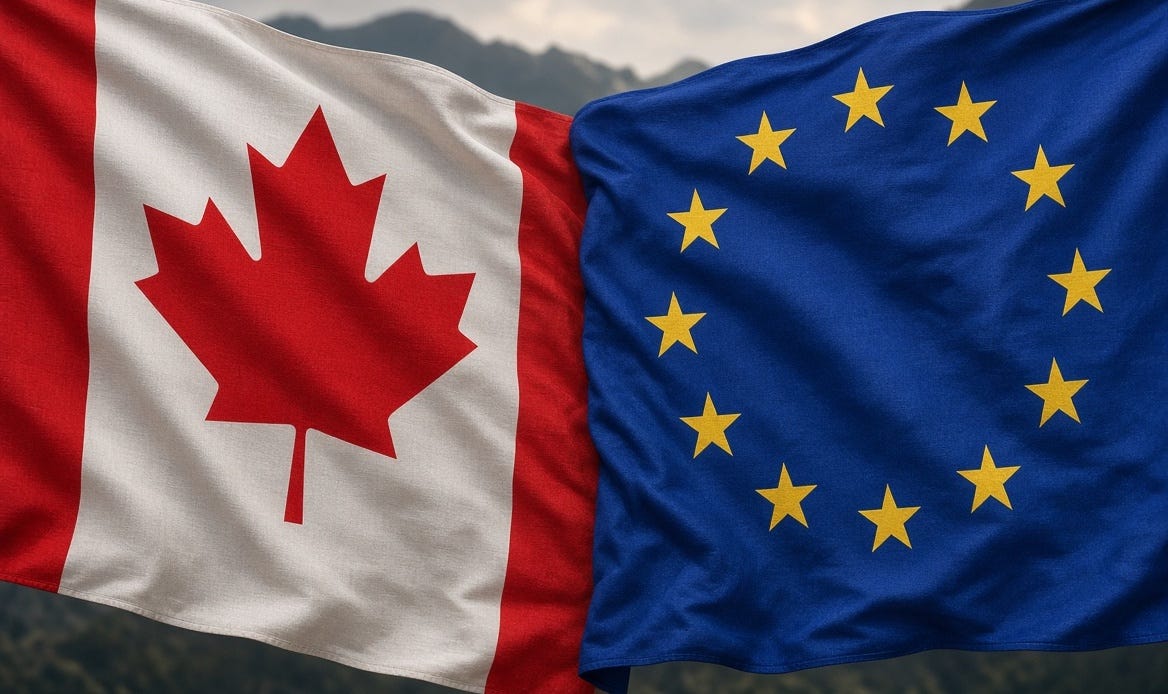
With Prime Minister Mark Carney hosting foreign investors at an elite two-day summit in Toronto this week and the development of what officials are calling a “unique” relationship with Europe, Canada is continuing to deepen its ties with the European Union.
But as the two jurisdictions move closer together on several fronts, including trade and defence, there’s at least one area where they are going in opposite directions: consumer protection.
For its part, the EU sees strengthening consumer laws and mechanisms as key to boosting market competitiveness and sovereignty in the face of an increasingly hostile United States and its dominant multinational firms. So far, Canada hasn’t acknowledged as much.
In June, for example, the EU bolstered existing click-to-cancel regulations, which require online sellers to make it as easy for consumers to terminate services as it is to sign up for them, with new 14-day refund rules. A month later, regulators added to airline passenger protections that are already considered to be the global gold standard by banning carry-on baggage and boarding pass printing fees, speeding up dispute processes and introducing the right to compensation for long tarmac delays, among other changes.
Canada, meanwhile, continues to lack meaningful online click-to-cancel measures and is in the process of controversially outsourcing airline passenger complaints to a third-party chosen by airlines. And, as reported here in May, the federal government is also shutting down the Office of Consumer Affairs, a department responsible for funding advocacy groups and their projects.
This divergence, Canadian consumer advocates say, highlights the federal government’s failure to acknowledge the role that such protections play in market competitiveness and sovereignty.
“Consumer protection remains an untapped opportunity for the federal government to deliver for Canadians,” says Keldon Bester, executive director of the Canadian Anti-Monopoly Project (CAMP). “In the case of the Office of Consumer Affairs there is evidence we’re going backwards.”
“If you’re selling shoes and you see your competitors doing weird stuff, you can attack their [interface].”
Europe’s new click-to-cancel enhancements require online merchants to add a prominent “withdrawal” button to their websites that allows consumers to reverse purchases and service contracts within 14 days.
The rules originate in Germany, where the Fair Consumers Contracts Act in 2022 gave customers the ability to easily cancel contracts and services they buy online. Courts have been strict in their considerations of potential violations since, particularly with U.S.-based tech giants.
Microsoft, for example, recently ran afoul of the regulations with its 365 service. The company did indeed have a cancellation button on its website, but a Munich court earlier this year found that requiring users to log in to terminate their service was too onerous since some may have lost access to their account. Microsoft was thus ordered to make it possible for subscribers to cancel without having to log in.
Satellite internet provider Starlink was also found to have violated the rules earlier this year by offering customers the option of deactivating their monthly payments rather than fully cancelling service. A Karlsruhe court ordered the company to be more transparent and to bring its processes into compliance with the two-click, full termination requirement.
Richard Glaser, an associate at the TaylorWessing law firm in Berlin, says the rules are so strict that competitors – not just consumers – can take violators to court.
“If you’re selling shoes and you see your competitors doing weird stuff, you can attack their [interface],” he tells Do Not Pass Go.
The EU is now adopting German-style rules because of the increasing use of dark patterns – deceptive design practices intended to frustrate and trap customers – particularly by large U.S.-based tech firms. This trend toward stronger protections is part of Europe’s larger move away from a reliance on American tech and companies.
“We were seeing, especially from U.S. clients, these kind of confirm-shaming customer experiences where you have a flow, like, ‘Do you want to cancel this contract? Do you really want to cancel this contract? And how about this survey? Can you please fill out this survey? But here’s a five-euro discount on our next product if you stay,’” Glaser says.
These sorts of practices are also rampant in Canada, but with the federal government largely absent on protections, the problem is being left to the provinces to handle.
British Columbia, for example, recently enacted click-to-cancel rules that require online sellers to make it easier for customers to terminate their services and subscriptions. But critics have pointed out loopholes, such as the fact that sellers are allowed to continue with multi-step retention efforts.
“When provinces do address the issue, they’re mirroring initiatives that started in Quebec and focus on contract terms and notification, not interface,” says Matt Hatfield, executive director of advocacy group Open Media. “This isn’t entirely wrong-headed, but is a very pre-internet way of thinking about the problem.”
“I’m expecting the next CCTS report, and several after, to be an absolute bloodbath.”
On the federal level, the Canadian Radio-television and Telecommunications Commission earlier this year announced that click-to-cancel rules are coming to one of the markets where they are most needed – telecom services – but not till April, 2027, at the earliest.
Consumer advocates have warned that the long runway gives telcos plenty of time to lobby the CRTC and federal government into implementing weak rules. Given recent history, the companies are also likely to look for loopholes or simply ignore the rules entirely, as in the recent cases of bans on activation fees and phone locking.
The CRTC is currently in the third month of an inquiry into new charges for device handling, shipping and SIM cards introduced by BELL, ROGERS and TELUS to coincide with the activation fee ban that went into effect in June.
The regulator also this summer allowed the carriers to temporarily lock the phones they sell despite a ban on the practice being in effect since 2017. Bell had not been following the rules regardless and, along with the other two companies, successfully convinced the CRTC that locks were needed to prevent theft at stores.
Consumer advocates are therefore concerned about what shape the incoming click-to-cancel rules might take.
“A consumer’s practical right to cancel a service and stop recurring charges should be universal and easy to exercise,” says Tahira Dawood, acting general counsel for the Public Interest Advocacy Centre. “We are not asking for anything extraordinary, only that consumers be able to exercise their choice to cancel a service freely and without unnecessary barriers.”
In the meantime, telecom customer complaints are exploding. The Commission for Complaints for Telecom-television Services (CCTS) in January reported it had received 23,647 complaints for the year ended July 31, 2025, a 17-per-cent increase from a year earlier and a new record high. It was the third record in a row reported by the industry ombudsman – a trend that is expected to worsen.
“I’m expecting the next CCTS report, and several after, to be an absolute bloodbath,” Hatfield says. “Big telecom companies are sharply slashing their customer service departments, replaced many agents with AI, and complaints were spiking before that took full force.”
“In Canada, the trend has been to empty passenger rights from any practical meaning.”
While Canadians lack the sorts of e-commerce protections that Europeans have, passenger advocates say the situation is even worse when it comes to airlines.
The government earlier this year announced a plan to shift responsibility for resolving passenger complaints away from the Canadian Transportation Agency to a third-party mediator chosen by airlines, including AIR CANADA and WESTJET. The system is being modelled on similar processes used in the United Kingdom and Europe and will speed up complaint resolution, according to the government. The current backlog of complaints sits at nearly 100,000.
But Gabor Lukacs, president of the Air Passenger Rights advocacy group, says that allowing airlines to choose the mediator is akin to putting the fox in charge of the hen house.
He also points out a key difference with the European system – that rulings by the Canadian adjudicator will be binding, whereas passengers in the EU are free to reject the third party’s findings and pursue other outcomes, including legal action. It’s a perverse system, he says, given that even the CCTS’s telecom decisions are not binding.
“In Canada, the trend has been to empty passenger rights from any practical meaning,” Lukacs tells Do Not Pass Go. “In sharp contrast, the EU has rejected the airlines’ lobbying efforts and shifted toward further strengthening of existing rights and addition of new rights.”
Ironically, Quebec just introduced a raft of new consumer protections, including click-to-cancel rules, a ban on fees for cancelling restaurant reservations and a prohibition on the resale of “ghost” concert tickets, among many others.
If Canada is intent on further aligning with the EU - whether it’s as an “associate member” or otherwise - consumer advocates say the federal government needs to strengthen consumer protection nevertheless if it’s serious about sovereignty. It needn’t be hard, with British Columbia and Quebec, historically the most European of the provinces, already serving as role models.
“[They’re] stepping up and putting their powers to use to make everyday life a bit easier for Canadians, and having the federal government move in the same direction would be a powerful combination,” says CAMP’s Bester.
🎧 ON THE PODCAST THIS WEEK:
✈️ AIRLINES
Speaking of airlines, PORTER and TRANSAT have received government bailouts to cope with the skyrocketing cost of jet fuel, which hit a three-month high last week. Montreal-based Transat has acquired a $150 million loan, the maximum available through the bailout, while Toronto-based Porter has received $125 million. The bailout program was announced in June through the Canada Enterprise Emergency Funding Corporation and runs till November. AIR CANADA and WESTJET have said they don’t need the loans, which are repayable within four years, with the latter calling it “market-distorting.”
And speaking of AIR PASSENGER RIGHTS, Lukacs’ group won a court battle in British Columbia last week that will allow consumers to take their disputes to the B.C. Civil Resolution Tribunal and bypass the backlogged Canadian Transportation Agency complaint system. The B.C. Court of Appeal overturned an earlier lower court ruling, which held that the Tribunal did not have the legal authority to hear airline passenger disputes. Lukacs told Global News that the appeal win gives passengers a speedier resolution option. The court’s decision may still be appealed to the Supreme Court of Canada.
🛒 GROCERIES
The Canadian International Trade Tribunal (CITT) says imported canned vegetables, mostly from the United States, are causing financial strain for domestic food processors and is recommending the government impose import limits and tariffs on them.
The CITT inquiry was ordered earlier this year by Finance Minister Francois-Philippe Champagne after domestic processors, led by Brossard, Que.-based NORTERA, complained about an increase in imports eating into its market share. Champagne followed up in June by imposing 10-per-cent tariffs on imported canned vegetables, though some products from the United States, Mexico, Israel and Chile were exempted.
Nortera told the CITT inquiry that it would be forced to lay off employees and close plants if imports were allowed to continue disrupting its business. The Tribunal acknowledged that its recommendations, if adopted, could lead to higher prices for consumers, but that this was an acceptable trade-off for protecting domestic production. The Tribunal also looked at frozen vegetable imports but found no sufficient increases to warrant action. In a press release, Champagne said the 10-per-cent tariffs on canned goods will remain in place for 200 days or until they are replaced by “final safeguard measures.”
The CITT’s recommendations come shortly after the Competition Bureau announced a challenge of Nortera’s acquisition of the Canadian subsidiary of B&G FOODS. The Bureau says the deal, which would give Nortera control over brands including Del Monte and Green Giant, is a “merger to monopoly” where the company would have 90 per cent market share in core canned vegetables and 80 per cent in frozen. In an affidavit supporting the challenge, the Bureau’s manager of competition law Jacqueline Byers says Nortera’s internal documents show that imports are not posing a significant problem for the company: “Nortera’s share remains significant relative to imports in all categories, and in some categories it has grown.”
Market observers believe the CITT’s conclusions reflect trade restrictions imposed by other countries that led to China dumping its surplus canned vegetables into Canada. The Tribunal’s recommendations, if implemented by the government, will indeed lead to higher prices for consumers.
“If Nortera wins the merger challenge, we could effectively end up with a monopoly and no meaningful external competitive threat in the canned vegetable market,” says Regina Seibel, an assistant professor of economics analysis and policy at the University of Toronto.
Food giants GENERAL MILLS and MARS are suing several top U.S. sugar producers, alleging that the companies have been engaging in a price-fixing conspiracy for years that has inflated the price for key ingredients in candy, cereal and many other products. The lawsuit, filed in federal court in Chicago, alleges that UNITED SUGAR, ASR GROUP and others shared confidential information with each other to illegally coordinate the prices food producers pay for sugar. United Sugar and ASR are also defendants in a related class-action suit in Minnesota, where they have denied the claims.
🏈 SPORTS
Cable giant ROGERS angered hockey fans again last week with news of extra fees for those who want to watch Sportsnet’s national Monday night NHL broadcasts and who don’t subscribe directly to the company’s services. Fans who get the Sportsnet television channel through a provider other than Rogers will need to log in to the Sportsnet+ streaming service online using their TV subscription credentials and, if they want to watch the Monday night games, pay an extra $13 a month. The news sparked heavy criticism online, with suggestions that Rogers is violating federal laws against tied selling and CRTC regulations that prohibit telecom firms from giving themselves undue preference in services they distribute to competitors. The company says it is working with other TV providers to give viewers access to Monday-night games as part of their subscriptions.
🛢️ RESOURCES
Consolidation in Canada’s oil patch continues its frenzied pace with TAMARACK VALLEY and HEADWATER EXPLORATION last week announcing a $10 billion merger. The combination of the two Calgary-based companies will create the largest publicly traded oil producer focused on Alberta’s Clearwater Formation, with non-core assets expected to be spun off into a separately listed company.
Not to be outdone, Calgary-based ENBRIDGE also last week announced that it is acquiring Colorado-based TALLGRASS ENERGY’s crude oil business for $2.5 billion (U.S.). The deal will expand Enbridge’s U.S. liquids pipeline network with a majority stake in the Pony Express Pipeline and other assets.
🚨 COMING UP
Making up just 1.7 per cent of the total box office take in Canada in 2025, it’s an understatement to say that Canadian films are under-performing at theatres. Why? Coinciding with the currently underway Toronto International Film Festival, the Network of Independent Cinema Exhibitors – a group representing more than 150 indie theatres across Canada – has released a new report that reveals some answers. Spoiler alert: it’s a competition problem. NICE founder and director SONYA YOKOTA WILLIAM joins the Do Not Pass Go podcast this Thursday to talk about how distributors and large theatre chains are holding back Canadian cinema.